Philippe Garrel and Breathing
- Zhang Yida
- Zhang Yida
“On peut dire que Philippe Garrel fait du cinéma comme l’on respire...” /
“It can be said that Philippe Garrel makes films the way one breathes...”1
- Jean-Luc Godard
“...In a way, a life also has a line, a vector. It wasn’t built from the outside: it’s the chronology
that demands it.”2
- Philippe Garrel
In 1968, three Parisian youths collaborated to make Actua 1, a “document of revolutionary affairs”. Serge Bard, Patrick Deval and Philippe Garrel were their names, and they belonged to Les Films Zanzibar. It was a short newsreel effort (albeit shot in 35mm) in which the people, always situated within their defined groups, only relate to each other through straight lines established by the camera. Its first word of proclamation (or is it one of denunciation?) is “alienation”, reverberating over a bridge in Paris occupied by the CRS. As Godard remembered, they were the only shots “where the CRS were shown full-face, with the sombre austerity of 35mm, while everyone else only worked with blurry 16mm...”3. A feigned sobriety that carries the traces of screams across the bridge in the last shot, in which the magnitude of the riot-control police vehicles induces an intense suffocation.
The stifling last shot of Actua 1 blew beyond the frontier of the film strip and into the world. Both Bard and Deval came to distance themselves from cinema, and the memory of this small film of actualities was all but blown away by the effacing breeze of time. Considered lost for nearly five decades, its rediscovery in 2014 reignited a flame to one of the central motifs in Philippe Garrel’s work. For Garrel, non-violent as he upholds himself to be, breathing comes closest to the violence that is elided in his films; not in the throwing of stones, but in a life lived with the constant approach of doubt, with desperate attempts at honesty, a life shaped by a past no longer remembered.
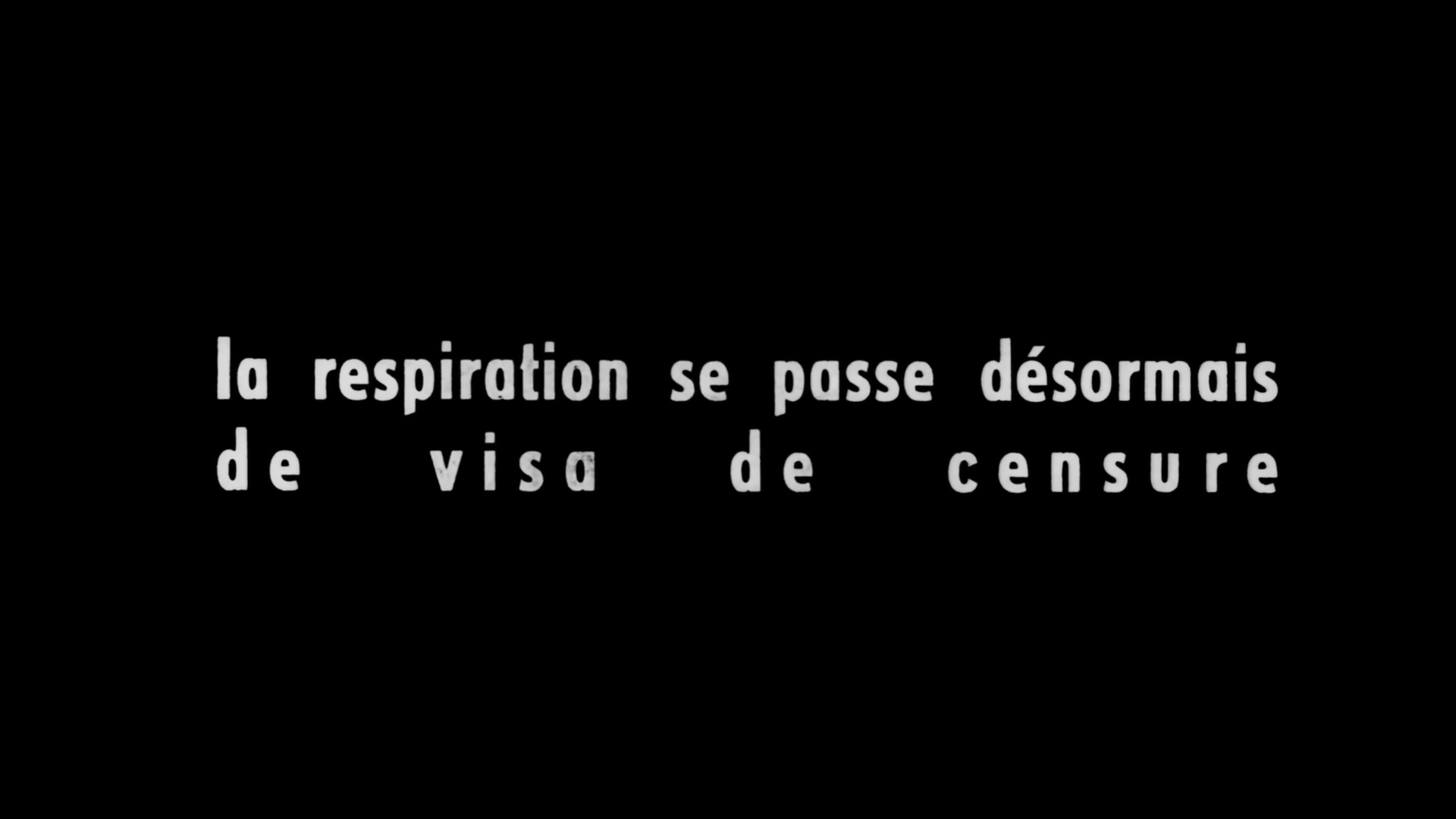
Actua 1 (1968)
Enfant désaccordé
Another motif was established in 1968, the backbone to Garrel’s cinema of breathing—with Le Révélateur, it became apparent that his camera only moved when it was explicitly guided to. The movement of the camera was treated as a matter of life and death, always aware of the irreversibility of action. Several months before, Bard, Deval, Garrel and Daniel Pommereulle had penned the Quatre Manifestes pour un cinéma violent, a decisive entry into what would become the Zanzibar period. Across the Atlantic, just a few months earlier, the Initial Statement of the Newsreel was penned by Robert Kramer. Down came a flood, and everyone was swept along. And yet, both in Le Révélateur and Kramer’s In the Country (1967), both about a family isolated in an abstract confined space (the couple in In the Country debate having a baby), there is already an overpowering fear of disillusionment, a perpetual self-interrogation of motives, hopes—from Adriano Aprà: a “neurosis of language”, the tailwind of revolution carried by words unspoken in the former and exclaimed in the latter. Then there is Bard’s Détruisez-vous, shot in April ‘68, where Caroline de Bendern tries in vain to “liberate” herself through words. Every action is a process of self-questioning. In his part of the Quatre Manifestes, Garrel outlined, in italics, the material of the film strip as “the material reflecting mental images”. This preoccupation with the unconscious, the inexpressible, a reflection bypassing language, this belief in an archaic primacy, of a need to extract something abstractly essential out of the real, now seems like nothing more than the construction of a self-imposed, foundational order around himself; “immature”, as Aprà called it. One recalls a young Garrel’s self-imposed diktat: “to make films for the price of a 2CV”4, a stubborn, blind self- confinement to a cinema of poverty.
It is difficult to live for cinema. It is difficult to make an example of yourself, so to speak, to lay out your foundations in the public eye. Garrel was lucky; he had both the Old and the New World as his comrades-in-arms. But there was no retrospective eye to look back at his life, just as there was no life to look back on but one that was merely “quotidian and anecdotal”5. This is the cruelty of youth: there is absolutely no way of knowing whether the fissures that seem to surround one’s life so completely are worth fussing over. In this regard, a likeness is found in Jonas Mekas, who also dealt with the quotidian and the anecdotal, who believed in carving his way through miles and miles of footage just to find the semblance of an adequate work through the process. But Garrel, who was still young, lived believing that he had already lived through it all, shutting himself off to the future. His integration of filmic work with life slowly brought about an intense examination of the quotidian, a leitmotif that would accompany his subsequent films through evolving approaches and irreversible realizations. But at what cost? Only time—years, decades.
In this first iteration, the camera’s motivator is the figure of the child. One notes that there is a desire for a return to origins. The silence of Le Révélateur stems from his vow of muteness, with a beam of light projected upon him, watching his parents enveloping themselves in insular theatrical gestures. There is then that magnificent sequence of agony, where the illusion of the stairs’ orientation is followed by him sitting on the opposite side, staring in distress at the camera. Shot in one week and edited in another6, the filmic role given to the child as the “developer” of the film material is not only a metaphorical one, but decidedly physical: he is not subjected to the same illusions that the adults construct around themselves, the same rules that they have set that have, at the same time, distanced them from an assumed reality. In this way, he is able to guide the camera at a safe distance from which to observe the fantasy of his parents, stranded in the depth of the film’s chasm. The efficacy of this mediation, however, is nothing more than ambiguous—the space of the Bavarian woods is itself condensed into a finite set, a world reduced to a continuous application of agonizing games and neglected signs. An escape route is posed at the end, where the play of shadows follows the child as he walks towards a body of water that surpasses geographical definition. He has escaped his familial life of signs, but to what avail? He still brings the clichés of allegory with him. If nothing else, this last shot is the revealer of some sort of abstract truth in conclusion: only through such painful rigour can there be a momentary glimpse of clarity. It would show Garrel if his self-isolation in the periphery still meant something.
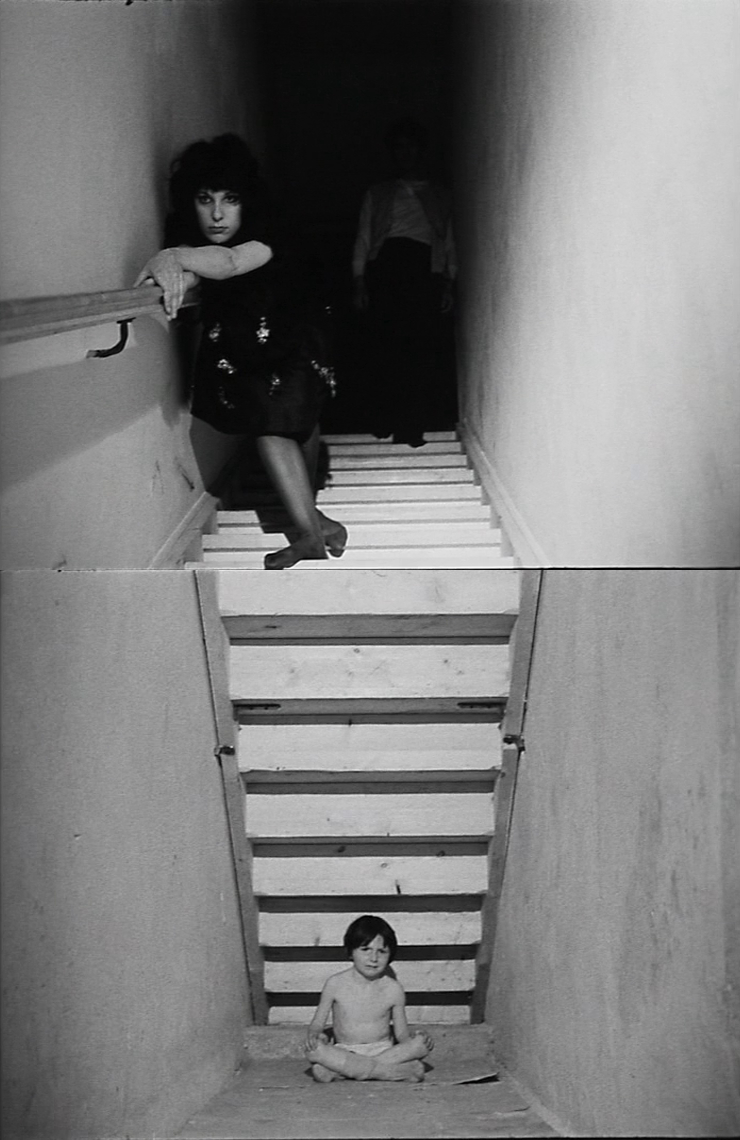
Le Révélateur (1968)
It is often the case that the arrival at truth gives way to a return to confusion. An important encounter with Andy Warhol took place in 1969, whom Garrel saw as the man “with nothing behind him”, “pale with fear, simply from existing”. “His films, at least the very first ones, didn’t tell stories, they simply expressed the mentality of the small community that surrounded him”7. From the man who filmed faces for hours on end, Garrel obtained the people behind the actors: Pierre Clémenti, Nico (who insisted on taking him to meet Warhol), Tina Aumont, Zouzou, Laurent Terzieff. Effectively, these men and women were no different to the men and women of someone like Howard Hawks, whose characters exist with such self- prescribed simplicity that they straddle the lines of performance and life. How else can Monroe and Russell flow so effortlessly through the screen, as if they were carried by a mere breeze—which is, indeed, the way they lived? Only Garrel’s cuts and camera movements are not driven by instinct as in Hawks’ films, but by a self-inflicted suffering that leaves no other choice in its wake. In this way, the simplicity of Garrel’s “characters” are the opposite of Hawks: they exist so heavily and forcefully in the film that, like Warhol, there is nothing behind them.
The early films were ones that took the body as a whole, to be recorded all at once. Breathing was thus considered a matter of life and death. A breath can represent both the very belief in survival, in the need to resist suffocation, but it can also herald the imminence of death. The answer to the hermeticism of Athanor (1972)—a “breath”, as per Garrel8—seems to be temporal: a return to the archaic (the time of the living?) that takes place through the shedding of stillness (the wooden log in the opening shot replaced by an ever-growing motif of fire), through a return to openness (Nico’s body, draped in a deathly black in the opening shot, is then shown unclothed). Nico and Musky embody all the Garrelian men and women whose subjectivity only exists in the peripheries and depths of the frame (the slight, seemingly arbitrary pan of Nico at the beginning of Les Hautes solitudes is the blow that makes her the observed). When they are in the center, unattached to a surface, they are almost completely immobile, passive. Alas, even under this obfuscated succession of images, they are still made to head towards death. Musky is left by the camera at the bottom of the castle walls, while Nico succumbs to death in that stunning image of the wooden barge, draped in black fabric, drifting in the dark water. She stops breathing. If even the age of the elements provides no safe harbor, then how is one supposed to survive now, in the lack of alchemy, in paranoia and violence?
The alchemy that the title of Athanor alludes to can be summarized as a constant, one-sided interaction of the film strip with the performers it harbors, a rare instance where the compactness of its signs is reasonably justified by an approach entailing a primeval treatment of the elements, devoid of vain expansions and distracting, spiritual clichés. It is, at once, a simple and ingenuous alchemical work and an indication that Garrel has still been unable to transcend the conventional trappings of metaphor. Like Renoir and Bazin, he believed in a sense of depth that would retain the enticing camaraderie of the performers, although his images were now becoming more and more flat, more unwilling to conceal things. This depth was thus attempted through the invocation of a divider between the actors and the frame, maintained by the persistent stillness of the camera and a resolution of silence. There are still secrets, of course, but they rely on a presupposed concreteness of the body. The act of breathing becomes purely objective. It seems that, in all the films up to Athanor, Garrel is striving for a momentary glimpse at an unfettered lucidity that sustains the belief in the vitality of fire and the darkness of death reflected in the water.
But this was an uncontrolled and uncontrollable death. The human body as a filmic unit must undoubtedly be morbid—a body as the outward projection of a human being is grounded in non-expressivity. There was no clear distinction between the body and the elements. Situated far on the other side of the divider, Garrel brought himself to prefigure the death of the love of his life.
A cinema of the face
Starting from Les Hautes solitudes, there is the realization that this morbidity would only be removed if faces were filmed instead. The bulk of breathing in Garrel’s films, up until now, had been obtained from the expanding and contracting of the diaphragm. The camera stays still to trace the minute movements of the static body. Now, we see the rise and fall of noses. With Les Hautes solitudes, Garrel shows that sometimes, it suffices to film a face, that this is all he needs to do for breathing to become unremarkable, to take on metaphorical terms. And how can one talk about faces in Garrel’s films without stopping at Les Hautes solitudes?
“Jean Seberg n’oublie jamais la caméra au contraire des films
de Warhol où les acteurs l’oublient complètement” /
“Jean Seberg never forgets the camera, contrary to
the films of Warhol where the actors forget it completely”
- Jean Seberg, Philippe Garrel et Les Hautes solitudes (1982),
Gérard Courant
At the beginning, there is Nico and the dark fabric, carrying over from the last shot of Athanor. It now acts like a curtain, confirmed by the black screen that signals the arrival of silence, the entryway into a mise en scène of the face. First, the discovery of a suitable face as the origin and centerpiece of the shot—the mise en scènique face, so to speak. Look at the eyes, the mouth, the nose, the cheeks. Jean Seberg’s face is as good a candidate as any: for so long deprived of a camera, which now invites it to keep rolling; a face without allure, with a certainty that presupposes suffering, always conscious not only of the camera, but of her own primacy in the mise en scène. The emanation of space and color (look at Renoir) begins with the logic of the face, free from the baggage of temporal causation attached to such a heavy role. Garrel said he cut the film “according to a harmonic rule [...] piece after piece [...] according to the dictates of light”9, but he missed one thing, something essential: he cut according to the dictates of light as they were moulded by the faces of people. Light, with the help of the expired film, is volatile upon the faces of Seberg and Aumont, Nico and Terzieff. It stays on the surface, so that each time faces move, they may be looked at with clarity. It is a film that makes you realize that you’ve never really seen a face. You can cut on a face, film a face for 5 minutes, maybe 10, maybe even 30; there will always be a logic to carry over, there will always be a thread to unite everything. Because a mise en scènique face allows time to dart around the frame, change its appearance constantly and abruptly. As long as the moving image is still able to entice any curious passerby to remain in its grasp for a few minutes, the face will play the role of seducer, drawing them away from the troubled rhythms of modern life. Like when Nico and Laurent Terzieff’s faces merge into Seberg’s in bed—the memory of sound disappears.
Garrel’s mise en scène of the face is curious, because it was no doubt derived from Warhol’s, who in turn got it from the Europeans. But it was perhaps Gregory Markopoulos, the American-Greek, who encapsulated Garrel’s ideals of the face the best: “Certain words fell into certain places, and when image and word fall together, they seem to have been put together deliberately.”10 It is precisely the case that, in Les Hautes solitudes, where there are no words to be heard, the image (the face) accommodates imagined words—the filmed face improvises, attaches to a sense of linearity yet allows the subsequent narrative to expand in all different directions. A filmed face is therefore a liberating space where all preconceptions are lost, where, very often, narrative aspires to nothing more than a logical succession of images. What Garrel demands (of us and of himself) is simple: one must first and foremost believe in seeing, then believe that seeing a face suffices, that it is grounded in a constant attraction and repulsion of certainty and uncertainty. The movements of the iris, the rhythm of breaths, the turning of one’s head at a certain speed put us at a vertiginous cliff, they make our hearts drop by presenting us with the most intense emotions possible. With Les Hautes solitudes, Garrel places himself as part of that rich lineage of teetering peripherals that arrived at the composition of their shots through the mise en scène of the face: Barnet, Carasco, Renoir, Schroeter, Warhol; as opposed to Hawks, Morrissey, Rossellini—also teetering, also peripheral, but representative of a cinema where the face must be seen with the logical pragmatism and independence of nature.
Like Rossellini, Garrel is quite resourceful when it comes to getting a great abundance of personal histories from the instability of the image in an otherwise “poor” frame. The fluid spaces of Les Hautes solitudes are not much unlike the places that surround characters in Germania anno zero and Stromboli. The only difference is what leads to what. It is a fact that, in a Garrelian shot, the number of objects in the décor can usually be counted with one’s fingers. Take the first shot of Jean Seberg in bed: just her, a very large pillow, a white blanket, the bars of the unseen headboard and the darkness beyond. Everything seems blown to proportions larger-than-life, and what is lighted and in the dark are one and the same. Then, the arrival of Tina Aumont: a curtain drawn to the side, a wall that seems to hover, a wall of light behind her. The images, which “can never reach fixedness, clarity”11, as Jean Douchet said, accommodate ellipses that Garrel requires the spectator to fill in; the progenitor of a dangerous, undefined infinitude, derived from images at once permanent and impermanent, heavy and light, immobile and jolting. He is one of the few filmmakers that can truly be said to have filmed the blurred and the misexposed as pristinely and precisely as Rossellini filmed the Franciscans frolicking around their mound.
If all Garrel did was film Jean Seberg’s face for 80-odd minutes, it would probably still be a good film; perhaps even a great one. But it would be too homogeneous, it would become a “character study”, which is expressly not the objective. The same follows in Raymonde Carasco’s Rupture, where Mireille Perrier’s face is complemented by Ogier’s, and in Boris Barnet’s U samogo sinego morya, where Yelena Kuzmina’s face is complemented by Sverdlin’s and Kryuchkov’s. In Les Hautes solitudes, across from Jean Seberg, there is Tina Aumont, the least Garrelian of “characters”. She is needed to film what isn’t possible with Seberg—she exists in willful inconsistency and defiance, possesses a sensuality of reason that may or may not turn violent—she is the one who enters through a doorway, and ends up confined to that magnificent reflecting table, to the dissatisfaction of the blurred image. Once again, the question: how certain can one be of oneself? After all, both Seberg and Aumont are filmed with the acknowledgement that their lives ultimately supersede their time on screen. If Seberg’s face is the pinnacle of certainty, Aumont’s face floats in the uncertainty of the filmed image.
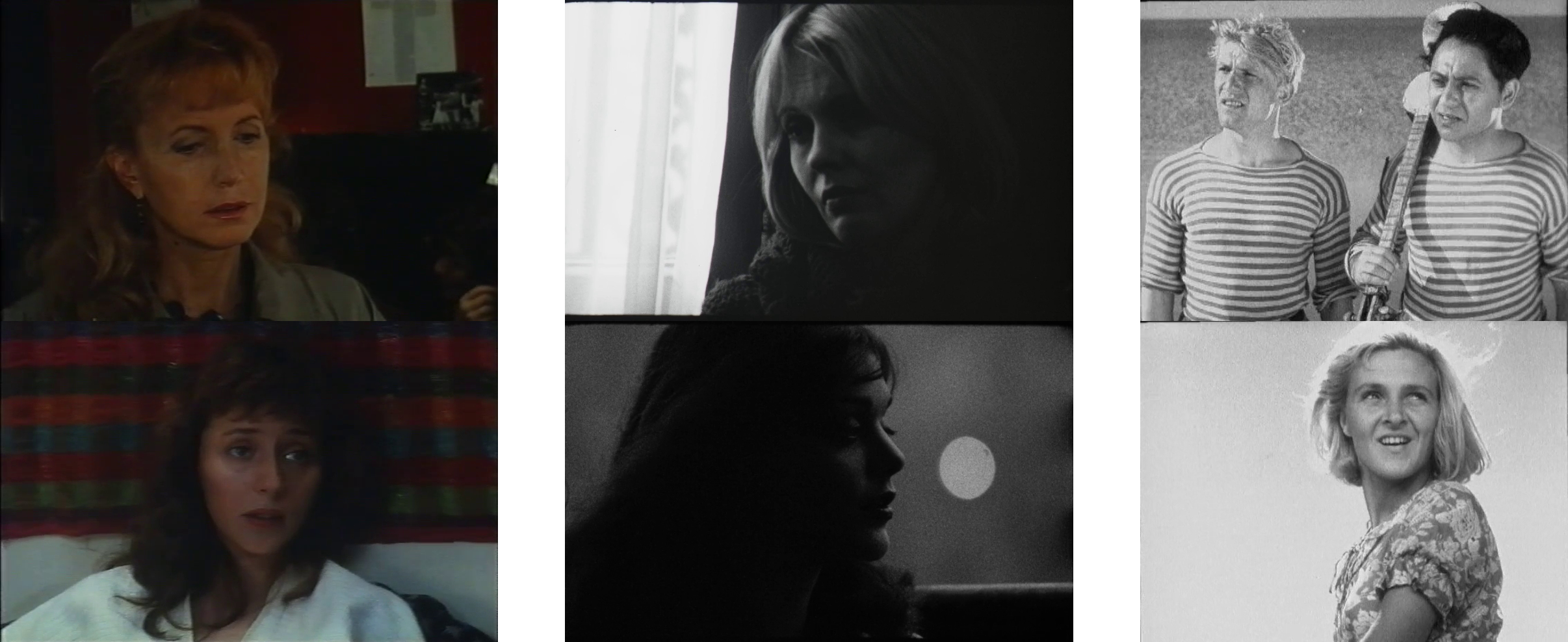
Rupture (1989) / Les Hautes solitudes (1974) / U samogo sinego morya (1936)
Throughout the film, one gets a sense of a “game” that Seberg perpetuates with the camera—the way she turns her head, the speed at which she blinks, seems to get lost in thought and returns with dogged focus. A fine actress, if there ever was one. So it is never as simple a matter as ‘the relationship between the individual and the camera’, contrary to what our most brilliant academics will suggest. If Garrel trains his camera on Jean Seberg to the point of anger or complete breakdown, it’s not because he wants to get at some theoretical relationship capable of appeasing inquisitive scholars (harmless curiosity, they believe), but because he’s interested in how fast feelings can truly change, how authentic this change may or may not be. It is incredible that Seberg’s face can go from rapt ure to desperation in an instant. It is honest. Honesty in Les Hautes solitudes is delicate, tentative; it comes from emotions that have been made to float at the surface, that leave vivid traces of their brief expression. An immediacy that allows Garrel to start walking hand in hand with those who he filmed, in the present, towards the future, not looking to the past.
The return to what can only be considered an interpretation of narrative cinema comes, incidentally, with the vanishing of a face. In 1979, Nico is gone, and with her Garrel’s desire to keep charging: “You have to be twenty years old to be smitten with a technique and an aesthetic and to invent a world. Today, this aspect doesn’t appeal to me anymore. I’d much rather be able to talk to people.”12. Talking entailed a more traditional narrative form— screenplays, camera setups, working with actors. Breathing would then take on an additional role: it would be equated to the very weight of the récit, not always obvious but capable of shattering the thin thread of the filmic material at necessity.
Watching L’Enfant secret (1979/1982)—still an attempt at making a silent film—there is the feeling that things move too fast. The camera stays still for minutes at a time, words come few and far between, faces rebel against the development of emotions (no wonder, when the couple is composed of two Bressonians). There is no longer the heaviness and density we are used to in classical compositions, nor the certainty of singular interpretations, nor even the clear ambiguity of a film that branches evenly in all directions. The propulsion of L’Enfant secret is typified in the way the film breathes: shallow, immobile, apt to creating lapses in the middle of a long take. It’s mad, madly made. The poverty of means is no longer imposed by himself.
The clapper says “Les Forêts désenchantées, GARREL”. It hearkens back to his first film, all the way back in 1964, which was to initially take on that title, only being called Les Enfants désaccordés upon the disapproval of his father13. It takes 4 and a half minutes for music to be introduced and 4 more for the first words to be spoken, with the exception of the “Vive l’anarchie” dryly shouted at the beginning (has it always been hiding behind his films, only becoming audible now, after 15 years?). Two young lovers meet each other at what seems to be the outhouse of a country home: the girl hops around outside, the boy emerges from within. They kiss and caress, standing on either side of the wooden door. The punk poster in their room exposes their dandyism and a shared desire for maternal nurture. This puts them at odds: they forget how to talk in all the silence, surrounded by fairytale rabbits on the wallpaper. They are still children; enfants désaccordés, as it were. They go downstairs, the girl now dressed in black. They huddle together in front of the fireplace. A page from a German book towers in the frame to Murnauesque proportions: we see Jean-Baptiste holding it next to the fireplace, the young couple now gone; they then return, and Jean-Baptiste is now gone. Fifteen years pass in this house in the woods, around the fireplace, the fire that keeps burning all these years and sustains the cut that glides over them. The traces of Nico are recalled from archaic letters.
That Jean-Baptiste is a stand-in for Garrel himself has already been known. Jean-Baptiste and Elie come into existence from the former’s film, which is also Garrel’s film. They come into existence from silence, and fall in love through the duration of a light, flimsy piece of music. The moment of happiness is so brief, and then they forget how to speak. They fall in love before names are exchanged, and when their names are finally exchanged, they have nothing more to say. So the question of weight appears: how are we to perceive the solidity of this couple that emerges out of the shadow of a film whose very title had been scrubbed and changed?
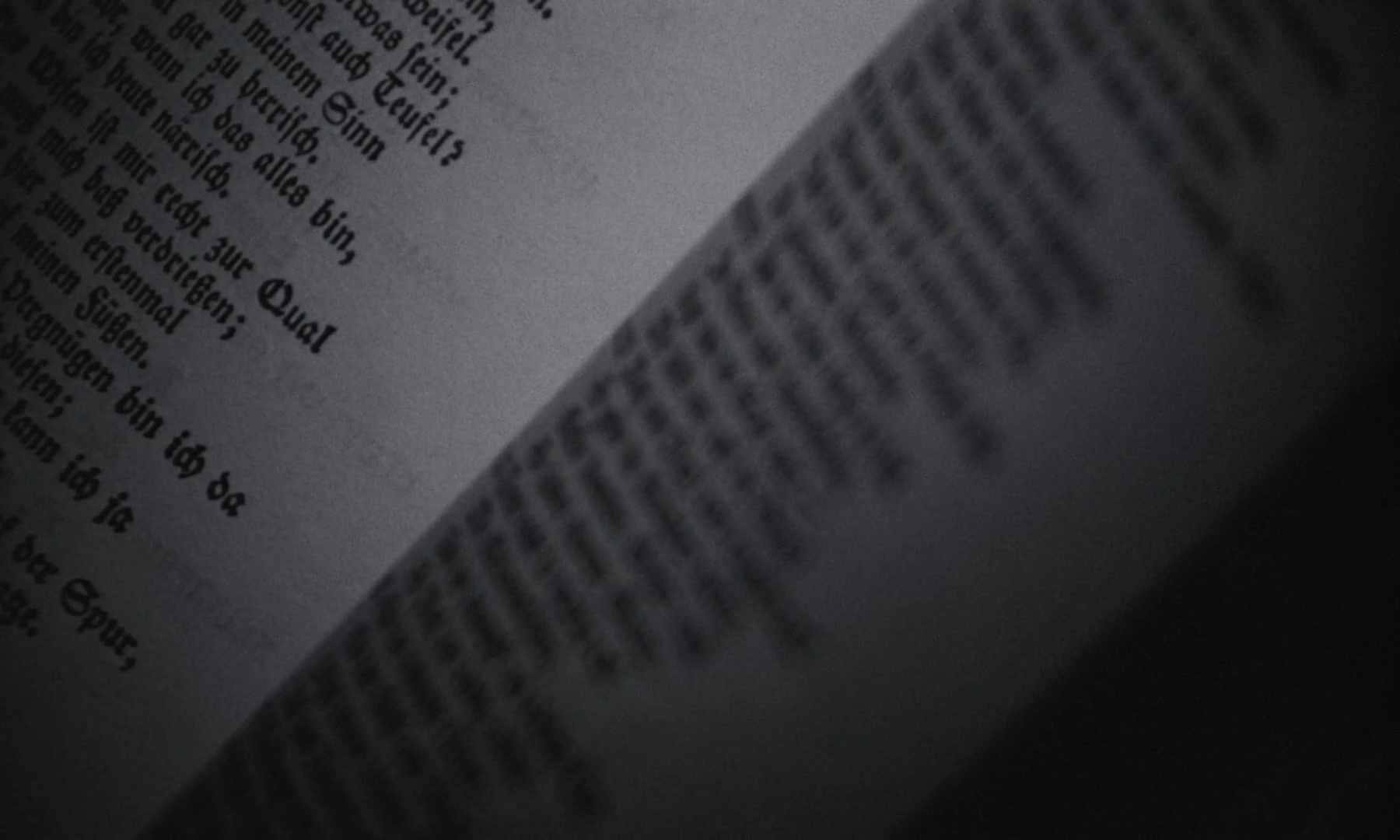
L'Enfant Secret (1979)
Or still, how are we to perceive the weight of words? The structure of L’Enfant Secret is composed essentially of a series of notes and terse descriptions that carry over directly from the preliminary scenario, also known as the Cahier Wademant—named after Annette Wademant, the “old-school” scriptwriter who worked with Ophüls, Becker and her husband Michel Boisrond, and who helped Garrel back onto the tracks of narrative film: “She didn’t write a line. She had simply been the interlocutor: she corrected some sequences. I delivered the scenes to her, and she judged whether a scene seemed necessary to me and to the dialogue that I had with her. She said no whenever a scene seemed to have been written for provocation.”14. What remains for the finished film is only the same suffocation of ellipsis: the same suffocation from the ending shot of Actua 1, the one image that has haunted the Garrel’s work with no conclusion in sight. So the impression will be the same, no matter if the notebook is read. The ruptures and reconciliations, the LSD episode, the time spent in the mental asylum, Jean-Baptiste cutting himself, the cuts cobbled together: they are all expected. There is no surprise, no awe-inspiring moment (save for one). The sections that divide the film are flimsy in the face of fate—they are merely words on a piece of paper, and they do what they do. Walls themselves become paper-thin in the face of the sudden declarations: Elie recounts a postcard written for her child, Jean-Baptiste asks about the value of secrets shown to the world, then decides that he will “abandon everything”. The whims of a filmmaker?
Habits are difficult to shake. It should come as no surprise that so many of the decisive moments of change in L’Enfant secret take place in silence. Sound, in the first film where Garrel plays by the book, is only a sign of honesty: it throws a spanner into the false sense of permanence that silence creates. But it is important to note that honesty, in Garrel’s films, is not necessarily an indication of miserabilism. It’s also honest when Jean-Baptiste’s friend pushes him towards Elie, it’s honest when he then embraces his lover and kisses her— it’s the hopeful gesture of someone who, ostensibly, still believes in love. The weightlessness that suffuses through each shot comes from all the people who still want to believe, despite the predetermined fate of autobiography that has been imposed upon them. Because the men and women who occupy Garrel’s frames come from a generation that wants, tries desperately to believe, despite having no idea if they still can. They have to keep living, to suspend their breath, in order to sustain this struggle for belief against the fragility of what little ties time together. Garrel, who began to shoot faces magnificently, could cheat the precarity of means, because the appeal of a face lies about a film’s budget.
There is only one sequence in L’Enfant secret that should be the object of our complete admiration. Perhaps it is a cruel prank, played in bad faith; perhaps it is the only provocation that slipped through. It is that ending sequence at the café, where Garrel manages, through two mere static shots, to topple space and reconfigure it altogether. Jean- Baptiste and Elie, who appear out of the fire, become confined between reflections, hovering; all they can speak of (if they can even be considered as speaking to each other) is loss: the lost love of a child, lost happiness. Elie walks out to get heroin from her dealer, depth collapses; the exterior vanishes in a single, merciless cut. She declares and declares, but it is only through silence that both reach communion. As it enters at the beginning, so it departs at the end: when it gets cut off, what Jean-Baptiste and Elie grasp onto is the very sense of weight that still hints towards the solidity of the world. It is at once the most confining and the most freeing shot of the film: space is deathly still, yet contorts from silence in inexpressible ways, and a single head of hair provides the only pathway to continue living.
In these dying seconds, Anne Wiazemsky reveals her hair for the camera by lowering her face onto the table. Elie and Jean-Baptiste find a way forward through a complete reconfiguration of the world, to which the face represents a more advanced stage to be reached. It is, perhaps, the only moment in the film where both come together upon the same decision. When a decision is made—whether or not to meet a friend for coffee, how to put food on the table—one grasps at a sense of weight that follows, the indication of some logical sense that puts a conclusion to things. The return to narrative has revealed that many of Garrel’s characters are engaged in a constant, unsatisfactory search for this final breath. The concentration of Garrel’s cinema into Anne Wiazemsky’s hair at the end of L’Enfant secret anticipates Rue Fontaine, where breathing becomes the very thread that unites the incongruities of life together, and the final breath is only found in death. Garrel’s first encounter with Jean Seberg is compressed into an assumed 14 minutes—he plays the friend that, a decade ago, first introduced her to him.
We are dealing with a cinema that has, across youth, towards the beginning of maturity, always been one of assumption. So it would seem that Garrel made a mistake choosing Jean-Pierre Léaud as his double: it seems that they are, in fact, people on the opposite poles of life. Léaud is perhaps the very antithesis of the Garrelian character: he overacts, breaks into frenetics with no apparent reason. He physically can’t stop moving—he practically never stops moving in these imperceptible 17 minutes, and when he does finally stop, the entire frame is recontextualized. Breathing, when Léaud is in the picture, always hearkens to the future, towards a space for himself to continue living. Unlike the contrast of Jean Seberg/Tina Aumont, who come together to comprise a homogeneous enclosure of being in Les Hautes solitudes, Jean-Pierre Léaud seems to represent at once both the uniquely Garrelian and the uniquely non-Garrelian. He encompasses them by carving an immediate reality out of every gesture he makes. He presents, and assumes the spectator’s knowledge: the shattered windows in René’s apartment indicates attempts at suicide, as we have seen so silently, so steadily, in L’Enfant secret (and in the smothering of the Wademant notebook); “ça va mal” means that René is nearly at wit’s end; René asking his friend for ten bucks is nothing else but a question of being broke (a matter of self-deprecating comedy). But there are then those gusts of wind that slide the disparate assumptions into place: the newspaper clipping announcing Génie/Jean Seberg’s death that Léaud/Garrel stumbles upon, literally from nowhere, and yet so precisely directional; René’s suicide, mirroring Génie’s, a mysterious force pulling him into death. The man who tries to barge his way through the present is surrounded by the propulsion of fate.
The birth of love
The first narrative films made after Nico’s death in the summer sunlight of Ibiza were Les Baisers de secours (1989) and J’entends plus la guitare (1991). Two films fervently about love, one in black and white, one in color. In J’entends..., the first narrative color film since Rue Fontaine, the camera consolidates a newfound openness; it opens up to breathing. Garrel finally allows it to move from one face or gesture to another, outside of what has been designated as the peripheries of the frame. This, in the 70s, would’ve been unseemly. Even in L’Enfant secret—this work that has ruminated from the tail-end of the decade to the beginning of the next (and everyone knows how much changes when the number changes), that starts a movement towards living for the present—the preoccupation with the confines of the geometrical space still dominated the movements of the camera. Les Baisers de secours is most important in this regard: the Garrels play themselves, surrounded by sunlight, and talk affirmatively, miraculously about love—they choose to keep living, and the camera submits to this willpower. Still, it moves resolutely only to reaffirm the confines of a space (the rehearsal, the encounter between the wife and the actress in her apartment), and stays obstinately still upon the possibility of expansion (the shots in the mountains). So when, in the very first shots of J’entends..., a whole geography is traversed between Régent/ter Steege or Perrier/Collette, new horizons are suddenly promised.
Where has this sudden impulse for life come from? For this we must go back to one moment in the middle of Les Baisers de secours, the one where Mathieu/Garrel picks up the newspaper; his breath stops for a moment, his eyes hover. On the back reads “Le Nouvelle Vague”, but this is secondary to a sudden glimmer of uncertainty in Garrel’s eyes. In fact, one is sure that, at this moment, it is Garrel who is sitting at the table. Could it be that he is reading about Nico’s death? Perhaps it is no coincidence that, afterwards, Garrel and Sy consummate their reconciliation, head on to the beautiful landscapes of the Vercors (to Mathieu’s mother), and talk about love with their friends. But Garrel is visibly shaken throughout the rest of the film. He has nothing to say after the train trip back to Paris, after rediscovering conjugal happiness. The film ends on a shot of subway tracks, upon which the actress playing his own wife has been sent off, having completely disappeared from the film since the half-hour mark.
It seems that Nico’s death has given Garrel a path to start catching up to the present. The awareness of the need for a definitive break has led, paradoxically, to a comedic approach—it is in laughter that the most devastating exorcism of the past can be committed ruthlessly. It never took long for Garrel to pick up the camera after the end of something. As if always lagging a step behind the honesty required for true acceptance, his camera is obliged to undertake the most humiliating duties. The men and women of J’entends... are filmed until their mystique is completely lost—the wind blows the past away, and what’s left is stagnant. The breath of the camera becomes hoarse when it goes from Johanna Ter Steege sewing in bed to Blasquez walking in and greeting her in German. There is no doubt that the actress is Dutch in origin. Is Mireille Perrier supposed to be Tina Aumont’s double? She slips away halfway into the film—just as Aumont slips away, after appearing in only two of Garrel’s films —after that wonderful scene in which no words are exchanged, and yet there is everything that is needed to send her off. Like a gust of wind that blows away, unnoticed.
What carries over from the past is that each of these Garrelian characters, no matter how long he or she has stayed off the frame, is constantly surrounded by a space that they themselves have created as an enclosure from a perceived exterior danger, becoming more and more difficult to break through. A devastating application of experience turned into habit, from a period of time whose memories they refuse to acknowledge. Portraiture in J’entends plus la guitare reveals this rarefied space between people that Daney spoke about—it’s a matter of the thickness of the air. When Garrel works with colour, what was once obtained from breaths is now obtained from the air, as if a photography imbued with the lightness of human touch would reveal how little these bohemians weigh in their surroundings. They are not phantoms, but it is no longer clear if they move through life driving themselves or being driven. The erroneous belief that they are still situated in the periphery exposes the many momentary slips in the image that transform the difficulty in communication between man and woman from an affirmation to a need for change. If Garrel’s cinema can be called humble, it’s because of this persistent, self-deprecating honesty, a realization of a duty to come to terms with his past, both as a person and as a filmmaker. The culmination of this humility is a film meant to be laughed at, where an obvious series of untruths is the most truthful gesture possible.
In these years, where cinema was playing catch-up to Garrel’s life, most of his films straddled with death through a general sense of angst for a future that may or may not exist: Le Révélateur, where it is uncertain if the construct of time alludes to a life past the end of the film; Actua 1, where there was no future. But there were also those that dealt directly with death: Athanor and Les Hautes solitudes, where death is explicitly prefigured, Rue Fontaine, which imagines Garrel’s own death after Seberg; J’entends plus la guitare, where Régent-Garrel visits Nico’s grave. Death, in Garrel’s cinema, is not the loss of life but the loss of breath, the ceasing of a wind that used to propel life and is no longer. Once this momentum is lost, the last major theme of the Garrelian character appears: a domesticity that finds false resistance in quarrels and extramarital affairs.
Let us allow Thomas Lescure to end this little exchange of breaths, where no longer hearing the guitar means nothing but the permeation of the domestic into the little that’s left. We are not quite sure what is lost, and Garrel doesn’t know either:
“When Gérard meditates on the closed slab that covers
Nico’s ashes, something comes to an end. We understand that
Garrel will never film like before again. At the end, a door
closes.”15
The film after the door closes is called Naissance de l’Amour. Garrel’s early narrative films do not shed their experiential quality precisely because there is still such a heavy reliance on assumption, on a generally pervasive feeling of uncertainty. All that has affected the spectator so deeply suffers from an immediate disappearance into the ineffable as soon as they leave the movie theater. The Birth of Love: the birth; of love. As we have seen from Emergency Kisses, love is already there, it just must be sung and danced around. This is a step backwards. War is now distant, on the television screen: the camera arrives at silence, while the individuals that compose a family are confined to a backdrop that couldn’t possibly be farther away from the real world.
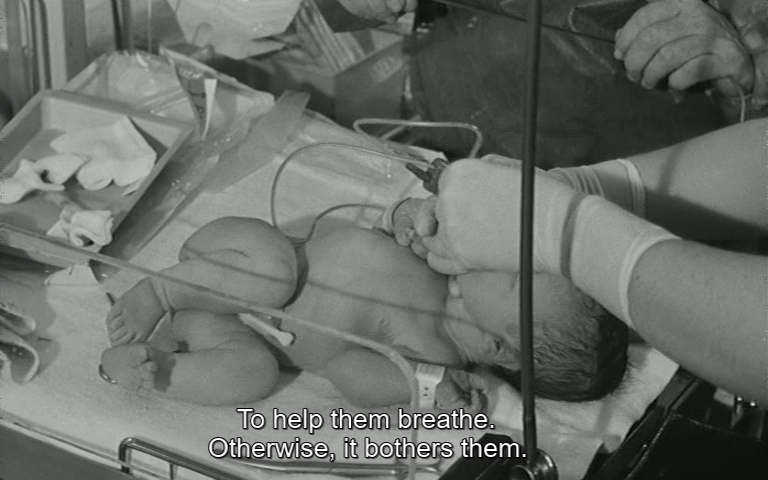
La naissance de l'amour (1993)