Faith and the reflections on its mirror
- Flo Mavy
- Flo Mavy
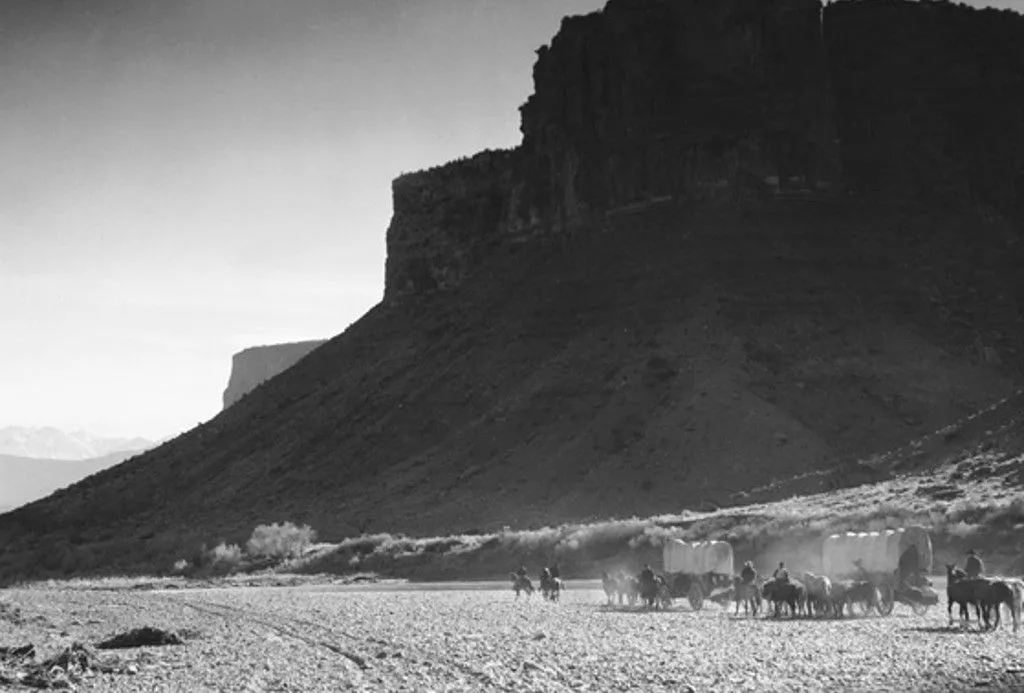
Wagon Master (1950)
To introduce this little text, I wish to quote a passage of communal illustration not least intriguing for the theme of this issue, which I read during a trip to London: the introduction to Honoré de Balzac's Eugénie Grandet, in which he describes the plurality of the residents in the village of Saumur, as well as the uniform motifs of Saumur both as a village and as a space of literal heterogeneity where nature exposes the conflict of human beings.
"In this country, as in Touraine, atmospheric vicissitudes control commercial life. Wine-growers, proprietors, wood-merchants, coopers, inn-keepers, mariners, all keep watch of the sun. They tremble when they go to bed lest they should hear in the morning of a frost in the night; they dread rain, wind, drought, and want water, heat, and clouds to suit their fancy. A perpetual duel goes on between the heavens and their terrestrial interests. The barometer smooths, saddens, or makes merry their countenances, turn and turn about. From end to end of this street, formerly the Grand’Rue de Saumur, the words: “Here’s golden weather,” are passed from door to door; or each man calls to his neighbor: “It rains Louis,” knowing well what a sunbeam or the opportune rainfall is bringing him." 1
What this short passage offers as a description is close to a social language (or observation in a simple way) of recomposition through human interactions. It is a reasoned pursuit towards every facet of our life in a world so much bigger than we thought it could be. Only history could preserve these neutral landscapes of John Ford’s Wagon Master and Roberto Rossellini’s Stromboli. Each reveals a light presented differently in their environments, becoming a projection of nature, imposing an order onto the bodies of our actors until their figures become precisely a testimony to their own stories. Here is where we begin to see the throwing of objects, running, fishing, climbing. Once the characters existed, and remain not as spectators but witnesses of the life that keeps surpassing them: it is a question of being human, to live among the whispers of the wind and the dust.
In Wagon Master, the journey of our primary characters coming to the aid of Mormon pioneers, the members and families of this group searching an empty territory, is the beginning of a preliminary stage of observation: the strategic operation of a myth that will open their existence like a window, inscribing the reflection of their life with the gestures it accompanies. It’s a film that refuses to impose subjectivity, but rather lets the parade of life be shown in its most gracious notes until it changes in direction, as Tag Gallagher mentions: "cuts back into flashbacks, back to passage rather than fulfillment, back to the past, to distance."2 A reverence to this natural contrast, where the days of the “old West” become nothing more than the sunny days that expose the elements of the land.
Connections arise between the landscapes and forms that once existed. The spontaneity of the frames, the adventures with beauty flow into the composition of the parades, prayers and masses as a geographical transmission of time whose memories history connects and preserves. To stumble into myth, we have to deal with a space like a cartographical map, where characters follow their own way and go far away into the horizon. Across mountains and rivers, temporal and spiritual bridges are built on the passages from soil to water, between the exteriors and the interiorities of a land with a hidden past. Through this passage, Wagon Master is the first step that Ford takes into orchestrating his own influences in the discovery of a unique rhythm to himself (a melody), from Murnau’s expressive leitmotifs to his master D.W. Griffith’s direction on performance: simple, just like Mozart’s symphonies.
We find history taking on the weight of enduring truth. In an instant, it drains out of the invisible—here comes a plurality of people telling their stories in a territory of a vanished past. The bravery they pronounce to each other blows their encounters into the path of legend, and the reality of the movements underline this very American violence despite the overwhelming vitality they discover in themselves. The frames made with constant movement —let the frames show us the landscapes where the figures of humans meet the wind, the dust and the crying horses! And then these cuts, virtuoso as they present themselves to us, they reign in the decisions of pursuit, of passage and of breaking falsification. The images and appearances that bring both Mormon and Navajo to become witnesses to the chase of stories for their own destiny, this maker of continuous rhythms that are never isolated. The story is never-ending.
It is not a coincidence that both of these films were released in the same year. They are like reflections, or, should we say, a mirrored conversation. The simplicity of Stromboli's gestures are never put in hierarchy. They straddle between the documentarian and the fictional in a process of looking at the unlimited variations of the present. Fragments of human actions contain contradictions to their own meanings, leading to a richness of expectations confronted, incomprehensible things accepted, such as the awakening of the volcano, which is carved out patiently and with profound resilience. Ingrid Bergman, carried along by history and its destiny, is given a story to tell and to participate in; she meets not only the harshness of a community built by migrated children and old villagers bound to exploitative work (the fishermen with the panicking sardines), but confronts a world that is losing confidence in human dignity. The volcano remains as the only place of precipitation—its essence of violent catastrophe imposes the people into a continuous order of the world, such that the movements of the island’s traditional rituals become like music, propelling the editing into constant, spontaneous movement. In Jacques Rivette’s letter on Rossellini, he sees the work of the director as seemingly embracing a melodious line of a painting that is trying to represent, through a care of shadows and light fading and projecting, a story searching for its breath, a trajectory that the protagonist calls to in urgency until the last shot, the moment when an end seems too distant from her, from Rossellini, and from the spectators. For Ford, it is a story of rebirth, taking place on earth; for Rossellini, it is a projection upon the sky. The geography changes when Ingrid/Karin is surrounded by the volcano’s ashes, but there is neither a separation nor a resemblance between what she feels in front of the world and what becomes visible from this recomposition: she remains a “human being” that has existed in the past and exists in the present, so impatient that time cannot stop.
Jean-Claude Biette, in On a cours d’histoire chez Rossellini, writes briefly in his introduction about the use of “street actors” that reflects the intuitions of the filmmaker’s creative process. Biette, mentioning the richness of social reality that Rossellini manages to capture, compares his method with actors bound to time and historical events as a development from Murnau. Another affinity with Ford, whose characters take part in the film and participate in it. The invention of Rossellini is not somehow the birth of a language of bodies (as Biette tells this to remind us of the origins of cinema and its ontological process), but the continuation of a history of transmission, with time as the only ally that persists in those precious gestures that secretly crystallise an entire life. Faces and figures of people become disarmed by time, this measure that reveals to every object an anvil of their existence and endows them with a universal law beyond the conflicts of the story: a resistance of being alive. He finds it in the island of Stromboli, in flesh and dirt. The light that hits the rocks of the island has the same nuances as Bergman’s shadows, bright and silken. Only her, except in the middle of the film, where she finds a child sitting on some stairs and wishes for this young boy to talk to her—the sounds of the villagers are far away, the landscapes around her gravitate not with emptiness but a quietness translated by tremors (is there whistling?); a space re- establishing itself. With Rossellini, he has to possess material, gather the masses of his resources and, with that kind of effort, he is engaging his understanding of the changes of his period, curious to find history even before his idealistic belief in television. In other words, la matière du monde.
Bodies offer confrontations, thoughts and accumulations that the film acknowledges as a testament to the real world. As with Ford, they represent perpetual passages in change, opening up a cataclysm with faith and redemption thanks to the material world. Look at the final minutes, where the cuts embrace the contrasts of the light, the dust flying above the air and the birds escaping the volcano's fury without anywhere to hide. But the reflection on Karin’s faith remains strong. Rossellini reminds Bergman that, even in a territory with no escape, this is a woman who "understands the value of the eternal truth"3 and that she should guide her into "complete freedom”. As he says of the girl, “in reality, she becomes another Saint Francis.” The creation of a passage to live and live on freely beyond all the contradictory roads and tragedies too overwhelming to bear.
They made these films in order to discover possibilities of learning with the world, the truthfulness of a total freedom by an accumulation of motions—a geographical operation. They also believe in embracing the relationships between the material and the abstract: more than strategic, an intuitive acceptance that time passes by and never stops, and provokes an impression of contrasts with our perceptions completely shattered and changed. The motifs that they search for become concrete extensions of space and light, from the one who runs in search of an unknown land to escape their past, and the other, who runs away from the island with no escape except her faith keeping her breath, struggling to find the vital necessity of living. An union of poetry and prose, typography and topography, that was once deeply appreciated in their hearts.
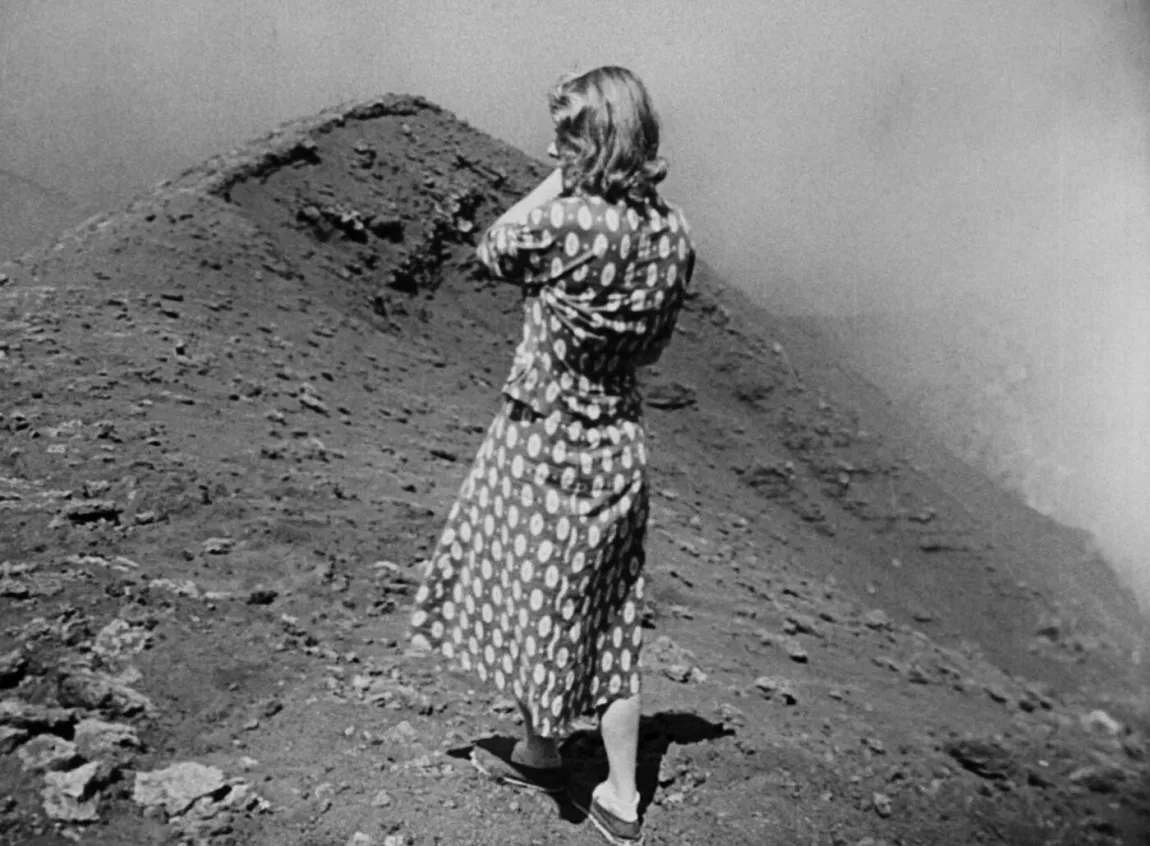
Stromboli (1950)