Introduction to the A. W. Method
- Adriano Aprà & Enzo Ungari (translated from the Italian by Giovanni Silveira)
- Adriano Aprà & Enzo Ungari (translated from the Italian by Giovanni Silveira)
"It’s as if his life were a byproduct… he’s an institution, like Walt Disney. Once he’s dead, Warhol’s films will still be there; as for Andy, his life will go on without him…” – Gerard Malanga
If you want to know all about Andy Warhol, just look at the surface of my paintings and films and me, and there I am. There’s nothing behind it” – Andy Warhol
1. WARHOL AND ITALY
To speak of Andy Warhol as a filmmaker, in the broadest sense that his activity allows us to attribute this term, means leading into a more or less constituted universe of discourse (that of film criticism), and into the specific field governed by this discourse (that of cinema), an object which, for one reason or another, has until now been hostile, if not altogether foreign.
The fact is that the aggrandizement of Warhol’s public persona has followed a rather tortuous path and, having left the pages of exhibition catalogues several years ago to enter, first discreetly then noisily, those of magazines, definitively cast aside the half-dozen publications that, in Italy, constitute the least provisional space of film criticism. On one hand, we saw, in its wake, the faint imprint left by his stars assume a physiognomy returned to us in the form of a bizarre and eccentric spectacle where all the torments and delights of the petit-bourgeois imagination of the 70s miraculously converge: drugs, promiscuity, licentiousness, exoticism, kitsch, homosexuality, transvestism, pornography. On the other hand, the titles of his films, the photographing of scenes, the hasty accounts of the supposed plots were never brought together in a recognizable manner. At best there remained, idealistically, those gestures, onto which the sparkler of some Italian epigone’s prose had become entangled. At worst, they became the reports, evidence and accessories that the customary criticism uses to give its arguments a minimum of pertinence. Before Leonardi’s book1, which dedicates to him a long and precise chapter, all that could be read about Warhol’s films amounted to a few imported articles2 or to brilliant accounts of visits to the Factory by certain Italian film-makers3. The image that emerged was that of an extravagant painter who devoted himself, between a Campbell’s Soup silkscreen and one of Elvis, to the making of provocatively long films about a New York skyscraper or about a sleeping man. For a long time, this activity continued to be judged as parasitic, a surplus of “creative energy” temporarily channeled into another place, where the production of Velvet Underground records and other oddities converged, attributed more to the manager-publicist than to the artist himself.
Thus the name of Warhol, constantly revitalized by news oscillating between scandal column, gossip column and crime column (like the shots fired at him by a virago in the summer of 1968), continued to resonate among the entourage of art dealers and, occasionally, with bold parallelism, among those interested in the developments of aleatoric music and the degeneration of rock; but no further than that.
2. ITALIAN CRITICISM
Nevertheless, this cinema exists and has not failed to leave an indelible mark on certain
experiences of modern cinema. In Italy, “Filmstudio ’70” screened some of his films (Couch,
Hedy, My Hustler, The Nude Restaurant, Bike Boy, Lonesome Cowboys, not to mention those directed by Paul Morrissey), but even direct confrontation failed to produce any breach4
in the attitude of specialized criticism. The fact that these films provoke such obstinate silence in the
critical field (the same silence, sometimes reversed into babbling delirium, that welcomes the
cinema of Jean-Marie Straub) is suspicious, at the very least, and not attributable to ignorance,
laziness or distraction. Indeed, as in Straub's case, it is no longer possible for criticism to take
shelter behind its own caution and examine, in these films, the “message”, the “idea”, the
“project”, the “style”, the “content”, the “form”, and all the other aspects of a parodic and
anachronistic repertoire.
Warhol's cinema, like Straub's, cannot be implicated, not even as a suspect, without calling into question the very instances that sustain the relevance and modalities of official critical practice today. In this sense, one can speak of a limit-cinema: it is not only the notions of “realism”, “verisimilitude”, and “enunciation” that prove insufficient or spurious; the very notions of “work”, “author”, and “discourse” are being distorted and re-postulated by films that, identifying themselves with their production process and making this relationship a theoretical reflection, produce knowledge and establish the field of a new problematic (the effects of which demand tools that the old criticism lacks). We are thus witnessing a decentering (in the sense that the original axis of cinematic reading has been corrected) and a dispossession (in the sense that the former holders of critical language, being unable to participate in this rectification, lose control of it).
The attitude of Italian criticism towards Warhol the filmmaker is, consequently, one of surrender in the face of an object that seems, by force of circumstance, unassailable: Warhol, the discriminated filmmaker (like everything that is subjected to censorship, removal, indifference), becomes an expression of those ignored experiences without which any discourse on cinema today would be nostalgic and retrospective.
3. AMERICAN CRITICISM
The place of Warhol's films (a mutable and vast place, capable of containing within its expanse
all the changes, folds and disguises of a landscape developed within brief and intense seasons)
overlooks an intersection from which at least two violently contradictory strands of cinema
project outwards.
On one hand, there is the cinema of “fiction” which, after an apparent destruction of the laws of narrative, the function of characters and the inviolability of plot (Eisenstein, Godard), seems to have reconstituted a new horizon of narrativity (Nagisa Oshima, Pierre Perrault, Robert Kramer, Jean-Marie Straub, Philippe Garrel, Eric Rohmer) and has, almost always, become a cinema of the word. On the other hand, direct-cinema, which, through the application of various techniques (from Robert Flaherty to Morris Engel) belonging to documentary, has definitively swept away the barriers between truth and falsehood, reality and artifice, cinema and life, exposing all their idealistic inconsistency (Jean Rouch). In Warhol’s case, his films are tenaciously intertwined with both the first and second strands. One characteristic of direct-cinema, and more specifically of cinema vérité, grown and developed within it, is the theoretical debt (especially for the epigones, such as Rogosin, Pennebaker, Zavattini) it has contracted with a spontaneous ideology, of which the notion of mirroring constitutes both the guarantee and the blind spot.
Unlike Italian criticism, American criticism has been commenting on Warhol’s cinema ever since its first appearance in the New American Cinema scene. But even in the case of Warhol's early films, those in which the reference to a primitive scene is most evident, it was more willing to focus on the randomness of the filming, the complete anarchy that seemed to reign on set, the absence of a traditional mise en scène, the technical amateurism of the production and, above all, the spontaneity of what was framed by the camera.
Within the N. A. C., the natural repository of every kind of abstract, informal, psychedelic and formalist experiment, Warhol’s cinema was immediately catalogued as a return to reality, to innocence, to the availability of the early experimenters and documentarians. This cinema, accounted for in terms of the effect of reality it produced, mistaken for that effect, thus became an additional, perhaps more daring, experiment in cinema-vérité, whose meaning is obtained in terms of immediacy, evidence, truth, “taking sides with things”, according to the (idealistic) idea of a camera that soaks up the moods of life, sucking them in, capturing them, without getting lost in useless formalisms, and that returns them more or less unchanged, in the form of a neutral and impassive record, hostile to any intervention and any sentimental contamination. Although cameras had no longer been fixed to their tripods for several years, the fact that Warhol’s early films did not contain the slightest camera movement was not received as a deliberate stance on the filmmaker’s part, but as something “natural".
Thus, in agreement with both the mystique of Jonas Mekas and the solid pragmatism of the New York Times, apologists and detractors alike found themselves entangled in the meshes of the same discourse. The apologists insist above all on the immediate relationship established between a Warhol film and its spectator, who, through this experience, would inadvertently pass from one continuum to another, in a dense and intense dialogue between his soul and that of the author, a muted dialogue from whose silence the voice of the things represented magically springs forth. This is the most ambitious goal to which Mekas’s critical lyricism aims. The other voice, that of the “establishment”, recuperates Warhol through the truth and brutality of what is represented. A representation that becomes, from time to time, authentic, brute, naked, crude, dense, convincing, indigestible, according to a low terminology (corresponding to Film Culture’s high one) oscillating between the language of the courts and that of self-service counters. Naturally, there are numerous exceptions in both critical camps, but what matters is the identity of the premises from which both official and underground culture seem to depart in their approach to Warhol’s films (a continuity, or short circuit, that should make us reflect on the presumed subversive character of what is placed beneath) and the economy that underlies their discourse. Mekas makes an investment (perhaps unconsciously): through the subjective exaltation of Warhol’s spontaneity, he aims to capitalize on the subjectivism and spontaneity that characterize the majority of the films distributed by the Film-makers’ Coop., of which Warhol’s films were, at least for a certain period, the leading titles5.
The New York Times, more shrewd and cynical, stakes a claim: it retains and emphasizes in Warhol those rather misleading elements that have materialized today in the films directed by his secretary-handyman Paul Morrissey (Flesh, Trash, Women in Revolt), who appeared on the entertainment scene like a long-awaited ghost to fulfill what Warhol seemed only to promise. In both cases, Warhol’s cinema is admitted, its existence acknowledged. This existence, however, is neither integral nor operative, insofar as it is subjected to a distortion that leads it back into the realm of the already seen and the already noted, and thus (in accordance with the Western metaphysics that identifies the act of seeing with that of knowing) of the already known.
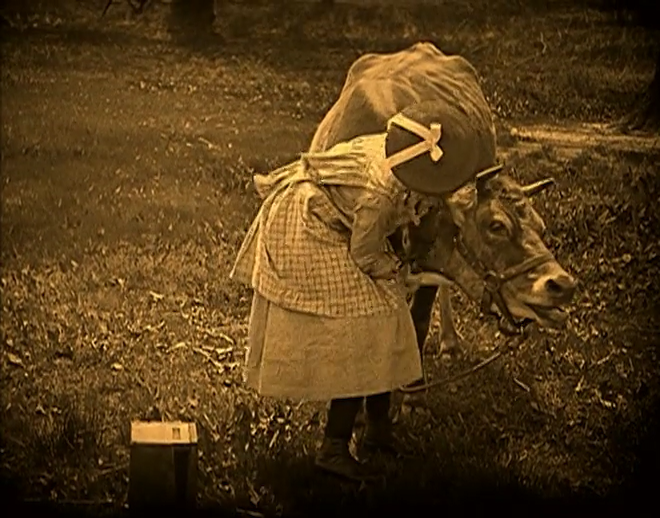
True Heart Susie (1919)
4. PAINTING, CINEMA
Once we have clarified the different ways in which Warhol's cinema was received, before
discussing his films, it is worth immediately addressing a particularly misleading aspect, one
that risks undermining the autonomy of a field (that of painting), of which we have no specific
knowledge.
What one apprehends from Andy Warhol’s early films (significantly without sound, without camera movement, without montage, without color, without mobile subjects) is first and foremost, even before a scene (curiously familiar) or an action (announced, prepared, expected and soon to come), a perspective. This observation, given Warhol’s background as a painter, is not merely obvious; it risks being equivocal. Indeed, it would be a mistake to see his early films as a tangent to, or a section of his painting. On the other hand, it would be even worse to isolate the films within the history of cinema, ignoring that their production is preceded, accompanied and followed by a great number of other experiences, and that they come from the foremost exponent of American pop art. To begin with, it can be noted that the films have nothing in common with the paintings of the same period (neither in subject matter, nor in themes, nor in figurative or stylistic rendering) but that, on the contrary, almost as if to emphasize their relative independence, Warhol made some paintings from his films (using, for the silkscreens, frames from Sleep, from Henry Geldzahler, to which he gave the title of another film: Couch; etc.), thus placing them on par with the Brillo boxes and Coca-Cola bottles, objects that already existed, completed before his intervention as a painter. This doubling (when reproduced in a book, the frame from Sleep and its silkscreen are indistinguishable) corresponds closely to Warhol’s tendency to probe the limits and boundaries of various techniques and disciplines, to measure their possibilities and to exhaust them. This type of practice, which involves the different fields in which the techniques are exercised (in Warhol’s case, at least up to now: painting, cinema, literature, theater, videotape, music), is twofold: on one hand, it seeks the autonomy of the various disciplines; on the other, through a series of abusive crossings and infractions, it undermines their inviolability by fusing them together (mixed-media experiences based on cinema, music and theater, such as The Exploding Plastic Inevitable; novels constructed using parts of soundtracks from previously made films, such as a; paintings produced using film frames, etc.). There is, therefore, no hierarchy among these different operations subject to the most exhaustive migrations. If anything, what connects them all to painting, to a certain teaching of painting, one that Warhol seems to have made the motto of his entire artistic practice, is the very definition of painting offered to us by Chou Wen-Chu: “Painting is made of boundaries. It resembles the paths that border fields"6.
To speak of a perspective in these silent films does not, therefore, mean alluding to a mechanistic continuity between painting and film. Within a non-chronological and non-linear time and space, where Warhol's artistic experiences are deposited, we can grasp the cinematic meaning of this perspective. The fixed camera will cease to appear to us as the anachronistic offering of an unassailable, privileged point of view, and in it we will recognize the representation of a representation: the one constituted by the originary scene of the earliest films in the history of cinema, a silent and immobile scene that, in its silence, aspires to words that technology and industry have not yet endowed it with.
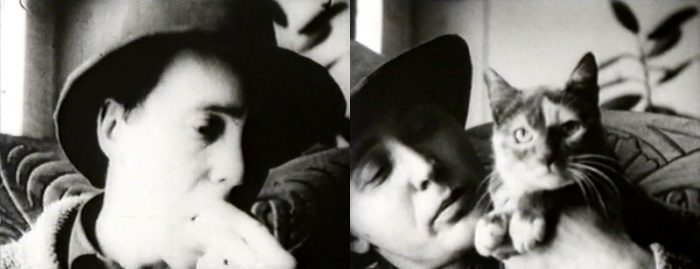
Eat (1963)
5. CINEMA AS PREHISTORY AND SCIENTIFIC DISCOVERY
This latter operation, which presides over every representation of a representation,
immediately delineates the pre-text of Andy Warhol’s early films, consisting above all of the
prehistoric films made by Norman Raff and Frank Gammon for the Kinetoscope Company, founded in 1892 by Edison, “the wizard of Menlo Park”, inventor of cinematographic film and
the phonograph that Villiers de l’Isle-Adam transformed into the hero of his novel L’Ève
future. Here, in the Black Maria, the first film studio in cinema history and the veritable
ancestor of the Factory, hundreds of films were shot for Edison's kinetoscope. Most of these films initially recorded the actions of
some character who stood in front of the camera. Fred Ott, already the hero
of a film made for the optical phonograph, Fred Ott's Gestures (1888),
was the protagonist of several films, among which the most famous is Fred
Ott's Sneeze (1894). The subject matter of some of Warhol's films seems to
extend this catalogue of obvious, banal, everyday acts, filmed in the same
conditions, one might say, as James Williamson's The Big Swallow (1901).
In Sleep, a man sleeps for the entire duration of the film; in Haircut, Billy Linich has his hair cut; in Eat, the painter Robert Indiana eats a mushroom; in Henry Geldzahler, the character smokes a cigar. These are not tendentious summaries, used to make the relationship between Warhol’s early cinema and the primitive scene more suggestive; in these films nothing else is described, we cannot be interested in anything else (except very abstract things, such as space, duration, etc.). Intertextual references become even more precise in Kiss (1963), which shows the kiss exchanged by several couples. An autonomous fragment of Kiss, Naomi and Rufus Kiss, stands as an exact counterpart to The May Irvin–John C. Rice Kiss (1896), also produced by Raff and Gammon for the Kinetoscope. On the other hand, Eat cannot help but bring to mind Louis Lumière's Le repas de bébé (1895), to which it seems to be linked by a respect for a spectator so primitive as to feel emotion, joy and satisfaction in seeing the most elementary and primary actions of his existence represented.
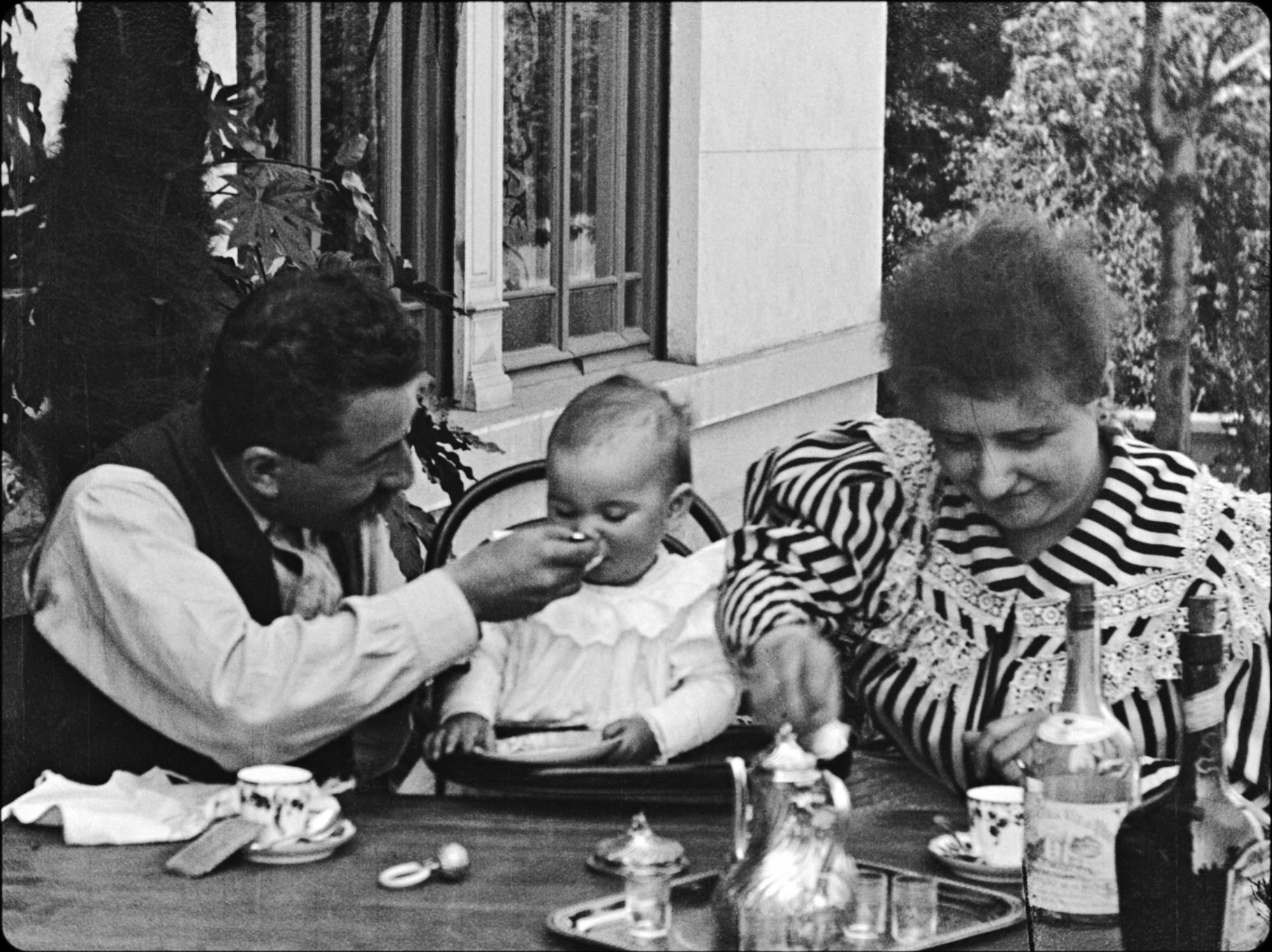
Le Repas de bébé (1895)
Dance Movie and Salome and Delilah, two of Warhol’s films about the feats of the dancer Freddy Herko, assisted in the second by Debbie Lee, become particularly significant if one considers that, in 1894, in Edison’s production, an important role was played by dance films such as Paddle Dance, Dance of Rejoicing, Silver Dance, Short Stick Dance and, most famous of all, Annabelle the Dancer, centered on a dancer imitating Loie Fuller, in line with the dances photographed by Muybridge in 1878.
In particular, what seems to be targeted and staged is the very principle that governed the execution of primitive films, not yet subjected to the obligation and constraint of having to tell a story. And yet, upon closer inspection, the scene in Sleep and Empire is produced according to a kind of arbitrariness entirely different from that which governed the shooting of an Edison or Lumière film. They are not separated solely by the inevitable absence of innocence that presides over Warhol’s set (it is not a matter of performing a retracing but of carrying out a rewriting). The most essential difference is that, whereas Edison and Lumière divided their concerns between projection and recording (so that the chosen scenes might amuse, involve or frighten the spectator), Warhol seems completely absorbed by the very act of filming. The only non-“primitive” film of his early period is, indeed, Andy Warhol Films Jack Smith Filming “Normal Love”, precisely because what is represented is the act of filming someone who is filming. It is no coincidence that cinematic prehistory interests Warhol as it marks the birth of the conditions of possibility for cinema itself.
What he seems to restore is not a mimesis of primitive films, but of the possibilities offered to cinema at its beginnings. Thus, it is not a history of film, but a history of the process of film production. If Warhol is unfaithful (in a modern sense) to the primitives at the moment when he represents them, he is their disciple in the attitude with which cinema is employed: even before being an occasion for spectacle, or worse, for “artiness”, it is a scientific invention. For Edison (but even more so for a predecessor like Muybridge, to whom Warhol has already made more than a few references in painting), the appeal of this invention lay in its ability to break down the fluid flow of life into fractions of a second, to analyze its movement, reconstruct it mechanically, and to reproduce it through projection in accordance with the laws of optics and dynamics. In Warhol, the exhibition of the film strip, of the ends of reels, perforated tails included, the presence, in the finished film, of all possible technical accidents (overexposure, underexposure, etc.) do not function to alienating effect, as in European experiments of cinema intruding upon cinema (Godard), but rather serve to further emphasize the fact that, in his films, the only spectacle is cinema itself (its conditions, its tools, its imperfections, its durations, the caprice of the camera). The Lumière spectator, watching L’arrivée d’un train en gare de La Ciotat, did not yet know what cinema was and screamed in fright, thinking that the train would burst from the screen into the theater. The Warhol spectator no longer knows what cinema is after having experienced it, and from here arises a different yet equally intense form of bewilderment.
Thus, after a long trajectory through which the author and the work came to occupy the entire horizon of cinematic reflection, Warhol’s “primitive” cinema reaffirms that it is the camera, the film strip, and the materiality of the film that define the latter. This statement does not align with the theory of a candid camera, whose virginity guarantees a direct relationship between reality and film (for this, see the cinematographic practice of Richard Leacock, D.A. Pennebaker, the Maysles brothers and other handheld camera funambulists). Rather, it foregrounds the absence of an “author,” of a master of the film, of a subject who guarantees the filmic discourse and its coherence, in favor of a process with which the film ends up, at least in part, identifying itself. Nothing more, nothing less. Or, to use Warhol’s own words, “the filming is the thing, not the film".
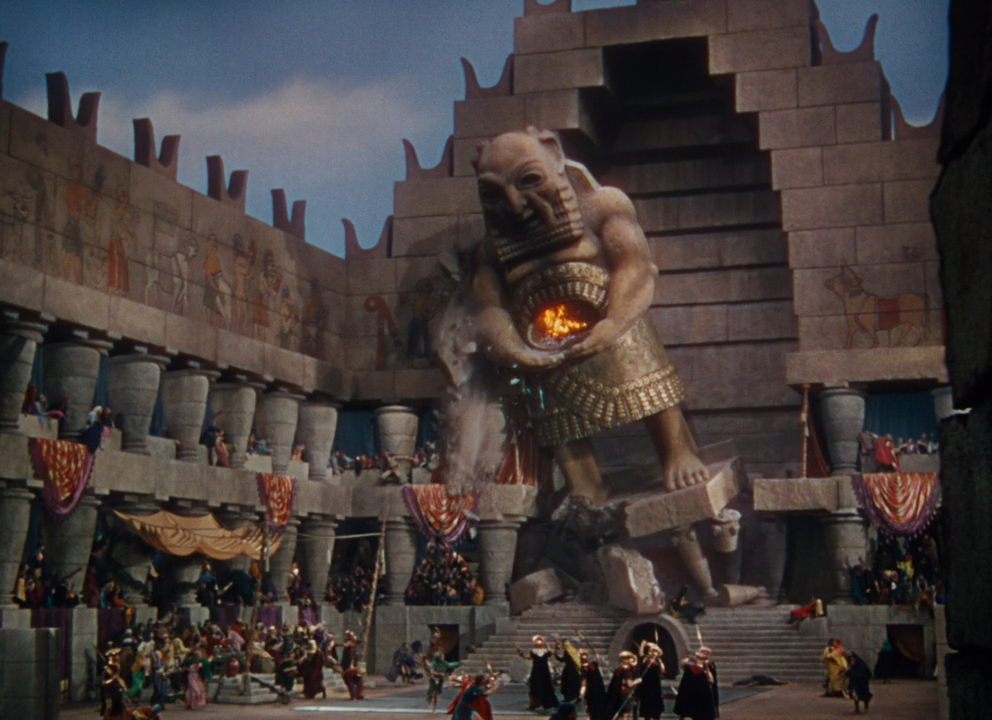
Samson and Delilah (1949)
6. WARHOL AND HOLLYWOOD: CINEMA AS SPECTACLE
But Warhol operates in America, and the cinema in America is no longer the invention of
cinema; it is the industry of spectacle: it is Hollywood. For Warhol, the representation of a
representation is first and foremost the spectacle of a spectacle, that is, a spectacle devoid of
any innocence. When Warhol films the Empire State Building (Empire), he is choosing an
object that is already mythological in itself. Once again, it is not a matter of filming the thing
(a New York skyscraper with a singularly suggestive name), but of filming the spectacularity of
that thing (the tallest skyscraper in New York, one of the wonders of the world, a reinforced-
concrete erection), dedicating to it a paradoxical and exhaustive epic. The final result does not
have the horror for “amusement” typical of American film subculture, even if the
entertainment it produces (or would like to produce) derives more from a theoretical
reflection on the consumption of the star (the Empire as the absolute star), on the cannibalism
inherent in stardom and on the exhaustion of the traditional star system, rather than
from a classical use of spectacular conventions. The Hollywood that Warhol often refers to, and which he seems to have
fed upon, albeit in a non-naive manner, is a mythological and nonexistent Hollywood,
the very same one that fuels the parodies of the Kuchar brothers and Jack Smith's
pornographic imagination. But rather than narcissistically and melancholically, in terms
of a lost spectacle or one to be rediscovered, Warhol sees it for its ancient productivity of stereotypes (stars, film genres).
His interest in the star (and in the entire dense and well-stocked hierarchy of the star system) was already evident in his painting, in numerous silkscreens (Marilyn Monroe, Marlon Brando, Liz Taylor, Troy Donahue, Warren Beatty, James Cagney, Elvis Presley, etc.) and, even earlier, in the days of À la recherche du shoe perdu, the very beginning of his graphic production seems to arise, through its “personalized” shoes and “foods”, under the sign of an anachronistic and unbalanced star system (Hedy Lamarr, Mae West, Zsa Zsa Gabor, Elvis Presley, Greta Garbo). In cinema, many of these names disappear. The stardom referred to in the films is no longer the “high” stardom of, for instance, Greta Garbo, Marlene Dietrich, Gene Tierney, and Louise Brooks, but a downgraded, kitschy stardom closer to the tastes of mass audiences than to the loves and infatuations of the cinephile: Lupe Velez, Lana Turner, Maria Montez, Jean Harlow, Hedy Lamarr, etc.
The principle seems to be to that of exhibiting (though the operation is so far removed from exhibitions and museums that it would be better to say "putting in a circus") an entire mythology taken from outside the set (hence the delirious "stage names" of the Warholian menagerie, right up to the very surname of Warhol, which happens to be an anagram of Harlow, and the stage name of Holly Woodlawn, where the mythical emblem is disguised through its division into first and last name).
The Factory itself seems to aim at reproducing a miniature Hollywood (today, in America, it is objectively the last place where stars are born and where spectacle is produced) operating in a completely closed cycle: production, projection and film distribution. If Warhol works at the Factory rather than in Hollywood, it is precisely because Hollywood today is no longer a producer of spectacle (at least the kind of spectacle dear to Warhol). It is evident that, despite the heavy constraints to which it has been subjected, the spirit of the cinema of Griffith, DeMille, of popular westerns, sophisticated comedies, parodic musicals and burlesque, finds a continuation today outside Hollywood (where this kind of legacy has been annihilated), in the underground and in Warhol in particular. Just as a certain universe of stardom survives only in his silkscreens, so the spirit of the Marx Brothers, Buster Keaton and Jerry Lewis, however degraded and corrupted, is still at work only in the indecent comedy of Mario Montez and the absurd and gesticulating comedy of Taylor Mead. Gerard Malanga is the last Troy Donahue, and female stars like Baby Jane Holzer, Beverly Grant, Edie Sedgwick, Ultra Violet, International Velvet, Viva and Ingrid Superstar do not constitute an island of mythologies laboriously wrested from the industry of spectacle, but a candid and corrupt zone where the notion of a star system exhibits the utmost artifice.
The Factory is at once the workshop where nothing produced must in any way be mistaken for arty, and the great department store that has long illuminated its display windows with the reflected light of a Hollywood that has been definitively extinguished. However, this parodic and glittery dimension somewhat constitutes the effect—albeit the most macroscopic—of a relationship (Warhol-Hollywood) that is articulated in a very profound and particular manner, that of interpretation of a material, of a text.
This text, made up of stardom and of genres, regains its full productivity the moment Warhol brings it back into operation. As for stardom, Warhol seems to have grasped the fact that the work of the star is the exhibition of an exhibitionist and, at the same time, their very justification.
Hence the portraiture of Mario Banana and the thematic interest Warhol seems to hold towards the “screen test” (the place where the limits and pertinence of this exhibition are put to the test), which becomes the subject of at least two films (Screen Test Number One and Screen Test Number Two). Warhol senses the funerary dimension of the celebrity phenomenon, the relationship that the collective unconscious immediately establishes between the star (unassailable by time, immortal) and their trajectory (fleeting, mortal, destined to be exhausted according to the mechanisms and rules of the same law that brought them to life).
In Lupe (about Lupe Velez), Hedy (about Hedy Lamarr) and More Milk Evette (about Lana Turner), the trajectory of stardom reveals its mortal aspect. In all three films, the process of beatification of the star fails insofar as the three actresses die at the end of the film.
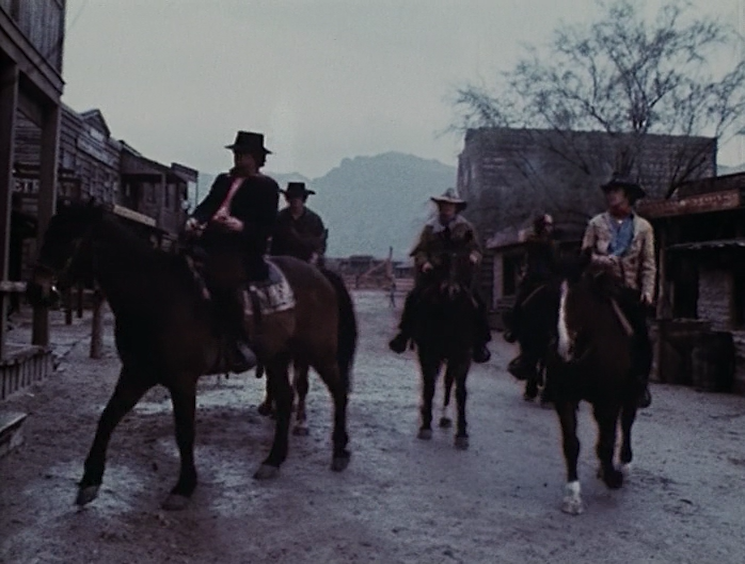
With regard to genres, Warhol seems to carry out the same kind of operation. From the vast array that Hollywood offers (melodrama, adventure film, science fiction, horror, Western, musical, screwball comedy, film noir, social film, etc.), Warhol appears to accept, in their conventions, only the Western, which he reprises twice with Horse and, above all, with Lonesome Cowboys. All the other films by Warhol (without counting the first, Tarzan and Jane Regained... Sort of), while drawing abundantly from the character, spirit and celebrity appendages of Hollywood in general, just as forcefully refuse to be confined within a genre, even if just for the sake of parody. The only two films that lead the spectator into the conventions of a pre-established genre are Couch and Blue Movie, which can be interpreted as a sort of synthesis and interpretation of pornographic cinema.
Lonesome Cowboys (1968)
It is quite well known that a number of modern filmmakers have felt the need to confront, at least once, the Western, considered the most cinematic genre of all, the one that, better than any other, sums up the lessons of American cinema in terms of action and behavior.
In this, Warhol is simply following in the footsteps of Monte Hellman (The Shooting, Ride in the Whirlwind), Jean-Luc Godard (Le vent d’est), Luc Moullet (Une aventure de Billy le Kid), Sergio Leone (C’era una volta il West, Giù la testa). Like them, for Warhol it is not a matter of making a fake Western, a parodic Western or a demystification of the Western, but of producing a true Western, presenting some of its production laws, revealing certain conventions, making manifest a dimension that the very status of the classical Western had kept latent (homosexual eroticism).
On the other hand, it is quite clear that the Western, as an approved form of expression, and pornographic cinema, as a repressed form of expression, are the two genres that, more than any others, base their economy on the principle of behavior.
In a certain sense, classical American cinema (the preferred setting for the itinerant hero) summarizes and concentrates to the maximum its core premise (the rejection of psychology in favor of behaviorism) in two ultra-formalized genres: the blue movie and the Western.
We can say for American cinema as a whole what Jacques Rivette said about Howard Hawks, the most American of filmmakers: “The steps of the hero define his destiny”7. Hence, the two shortest shortcuts to the universe in which immobility and the cessation of action coincide with the death of the hero and the end of the film are represented by these two extremely regulated genres (escapes, shootouts, saloon brawls, horseback chases, ambushes and torture function, from the point of view of bodily exhaustion, as a prelude to the preparation and performance of sexual acts), in which the itinerant hero and the sexual hero conclude their trajectories with a catharsis or a detumescence.
Couch unfolds entirely through “root” scenes (according to the serial principles of Kiss and the rules of any good pornographic film that scorns preambles and justifications), while Blue Movie, preferring an "analytical" point of view over a “synthetic” one, deals in practice with a single extended sexual encounter between a man and a woman.
Hollywood cinema, brought back to its origin as a vehicle for action, is therefore, for Warhol, a text about bodies (of which stars are the permanent embodiment, the objects of the masses’ desire) and genres (the field in which the body is sheltered from psychological concerns).
7. THE CINEMA OF WARHOL: BODIES AND SPEECH
The early films of Andy Warhol (which are the necessary point of departure for any thematic
analysis), though devoid of speech, seem constantly to announce its arrival. The spoken word is
a kind of absence that flows actively between the characters and the camera. Paradoxically, in
order to make evident the fact that modern cinema has definitively become a cinema of the
word, it was necessary for this silence to be produced, in which images seem to drown and
characters seem to lose themselves. From this mute and immobile story, Warhol unhesitatingly
chooses the bodies, which ultimately become its blindest and most irreducible trace.
My Hustler (1966)
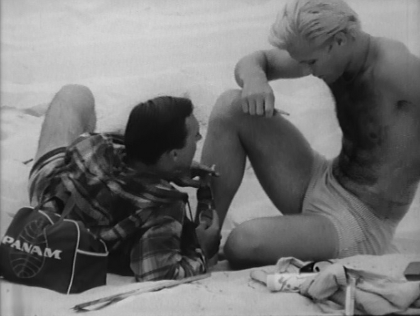
The word is still a word to come, but the presence of bodies laid bare is a kind of biological anticipation of it. They are the reservoirs of this word that has yet to emerge. Because of this deferral, the characters have only their bodies to communicate their desires and needs. The main activity recorded in these films is precisely that of physical gratification. If there are emotions, they are purely physical because everything, beginning from feelings and psychology, is reduced to pure behavior. Sleeping, eating, smoking, kissing are filmed as primordial and everyday acts, represented in their real durations. In Blow Job, a young man receives fellatio from someone off-screen. The attainment of sexual gratification is made clear from his relaxed features and from a purely physical action: the young man lights a cigarette and calmly takes a few puffs. In Couch, a group of people eat bananas, a man performs fellatio on another, two men and a woman make love stretched out on the couch that gives the film its title. These acts, or tributes, are practiced impassively because the faces do not matter; only the bodies are important. At times the characters look into the camera, move their lips, as if they also wanted to produce a commentary on their own actions. Mario Montez, one of the most tireless talkers in Warhol’s cinema, makes, during the silent period, Mario Banana, in which he eats a banana for the entire duration. Mouths consummate indeed every kind of oral act, except that of turning their mute movement into speech.
Unsurprisingly, the most frequent sexual acts in the silent films are kissing (men and women, men and men, women and women) and fellatio. All needs seem to be fulfilled by the mouth which, only in this incessant activity, finds partial compensation for the prohibition against emitting sounds.
Finally, sound, and with it the spoken word, enters and becomes part of Warhol's cinema. It was at the end of 1964, with Harlot, based on a text by Ronald Tavel, that the spoken word came into play; and significantly, they were synchronized words, not dubbed in post-production.
The introduction of the spoken word immediately announces itself as a traumatic event: it is something violent, no less so than the camera, allied together to martyrize the actors. In Screen Test Number Two, Mario Montez is confronted with a text that is not his own, and an off-screen voice (that of Ronald Tavel, that is, the master of those words) reproaches him for being incapable of reading and performing it. This violence of the text is also violence within the text. Throughout the period of Warhol’s collaboration with Tavel, violence is not only the discourse but also the content of that discourse (up to the ultraviolence of Vinyl). Indeed, spoken word and violence arrive simultaneously to shatter the calmest, slowest, most inexpressive of universes.
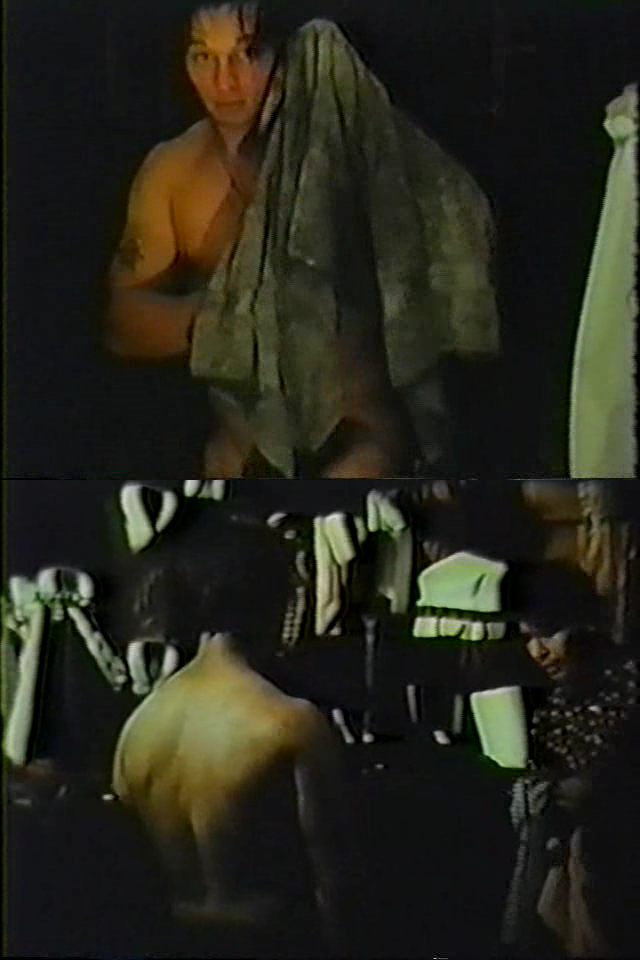
The body and the spoken word now occupy contiguous roles and constantly expose a form of congenital rivalry, supplying a parody of a “low” level and a “high” level abruptly brought close together. Even later, when Tavel would leave Warhol's set, this rift remained, separating those who hold the power of speech from those devoid of it, and the body from the speech that it stores. In Drunk, for example, director Emile De Antonio starts two actions simultaneously: speaking in front of the camera and drinking liquor. These two different orders of needs display their incompatibility in the most obvious and convincing way. The gratification of the body (the act of drinking) begins to disturb the exposition: the order in which the spoken word manifests itself. By the end of the film, De Antonio, completely drunk, is unable to produce anything but senseless babbling. In My Hustler, we can observe another aspect of this muffled struggle. In this film, composed of enclosures and perimeters whose patient geometry we will gradually discern, the most precise rift is the one that separates the young hustler, who is in possession only of his own body, from the people surrounding him, who are in possession of speech. The film records the trajectories that lead the characters to cross the line between two spaces (that of the body, constituted by the beach where the young man exposes his body to the rays of the sun, spreads sunscreen on himself, etc.; and that of speech, constituted by a veranda of the house by the sea, where an intense commentary ensues from all those who long to reach the boy's body). From this point of view, the film ends up being the commentary of a silent body, performed by multiple instances of speech. Bike Boy is even more significant. It can be described, without fear of betrayal, as the vicissitudes of a body subjected to a number of aggressions from the spoken word. The body belongs to a young motorcyclist (Joe Spencer) who immediately presents himself as hostile and alien to the possibilities of discourse (Spencer is semiliterate, almost never manages to give logical coherence to his speech, and over the course of the film completes only a few sentences). The film opens on a naked Joe Spencer taking a shower with evident contentment. This long sequence, orchestrated in warm tones, corresponds fully to the presentation of the character, replaced here by his physical description. The setting then shifts to a boutique, where a predominantly homosexual clientele is trying on T-shirts and swimsuits. Bodies dressing and undressing are accompanied by bits of dialogue exchanged between the shop assistants and Spencer, as well as other customers, almost always off-screen. Up to this point, the spoken word is as if relegated to the margins and, in a certain sense, remains separate from the body. But the rest of the film is reduced to the description of Spencer’s encounters with four women, in four different interiors of the same house, during which the girls bombard him with an interminable verbal logorrhea. Each of these encounters contains the premises of a sexual development (one of the women bares her breasts, another lies stretched out on a bed, a third caresses and sucks on a bottle of Coca-Cola the whole time, and the last actually undresses and invites Spencer to undress himself, after having laid down on a sofa). The fact is that the response of the four female bodies is completely subject to the dominion of the spoken word, which transforms these encounters into confrontations. During the final encounter, Viva’s speech possesses such strength that it prevents Spencer from achieving an erection, and the film closes on the woman’s mocking laughter. This odyssey of bodies in a world now devoted to the word unfolds differently from films like Lonesome Cowboys and Blue Movie (where a kind of reparation, remedy or truce to this rivalry is sought) and is foreshadowed, in a violently parodic manner, by The Nude Restaurant. The film takes place in a bar where customers chatter at the tables, after having taken off all their clothes. The restaurant, the natural venue for the articulation of oral needs (eating, drinking), and the absence of clothing (a sign of the bodies' amorous availability) are reduced to mere elements of the décor by the very demands of language, now definitively sovereign. It can be said that, in The Nude Restaurant, speech, as a superior authority (but also as a parody of this superiority), has completely replaced all other oral or physical activity. Men and women speak incessantly, completely absorbed by this faculty that shields them from their own desires, just as the lowered shutter shields them from the looks of passersby (while the camera exposes them to those of the spectators).
Bike Boy (1967)
8. SPACE AND EDITING
Warhol’s cinema, in its rather rapid evolution, which leads him to the use and the exhaustion
of ever-new techniques, moves toward the search for a new space to replace one that has been
completely worn out.
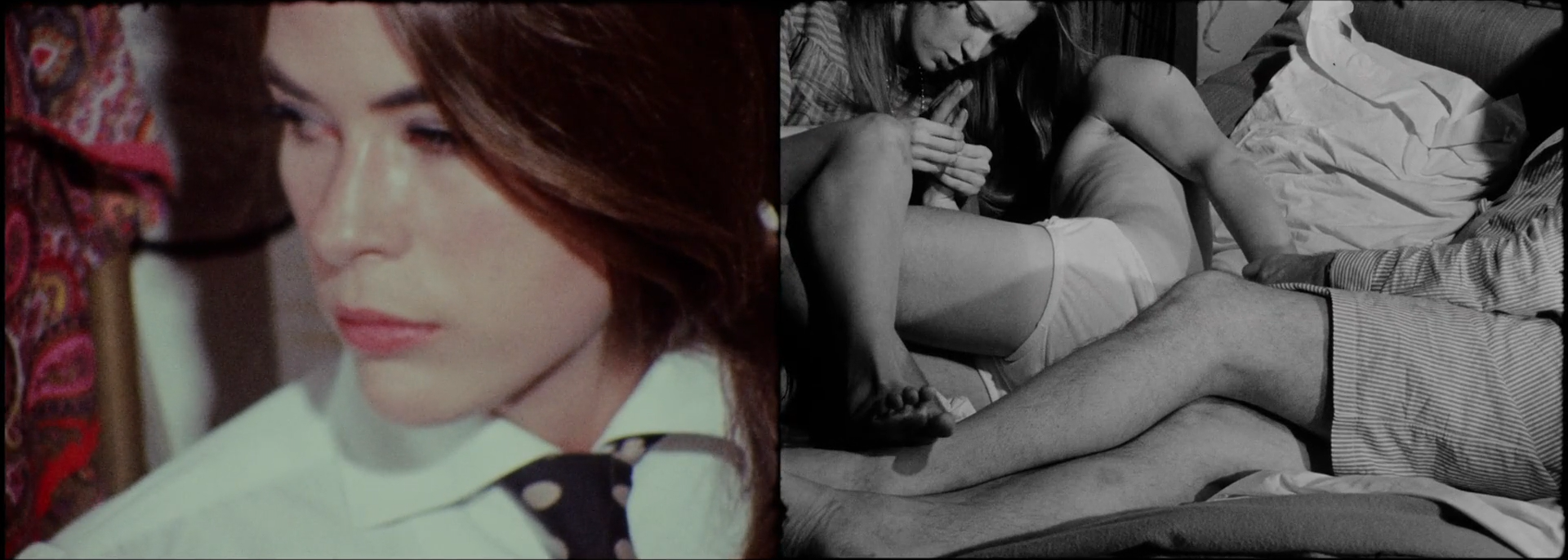
The lost space—the one called into question by the early films—can be defined, at least initially, as a “Renaissance” space, founded upon a dominant point of view, summed up by the use of the fixed frame and modeled on fifteenth-century perspective. But this space, once staged and affirmed (its negation will never be a denial, a placing in parentheses), is gradually expanded through the use of off-screen space, a space that is “unseen” by definition, “other”, in relation to which the composition of the traditional frame defines itself and finds its raison d’être. Warhol promotes the existence of this invisibility, especially in a film, Blow Job, where the on- screen space is a base, inert space, a sounding board for the effect, the echo (the boy’s expression) of what takes place in the off-screen space, an active space in which the action is carried out (the fellatio that someone performs on the on-screen subject), whose time and duration determine the progression and conclusion of the film. Off-screen space further affirms its own existence in films such as Harlot and Screen Test Number Two, where sound and speech originate from this invisibility that oppresses the faces of the characters and stimulates the very unfolding of the action. What is thus called into question is the conception of the screen as a picture frame (outside the screen there is everything, it’s just that we cannot see it). Certain titles of films made during this period, such as Space and Outer and Inner Space, are particularly revealing of this search for a subverted space. This is the space of Kitchen8, where the elements on-screen and off-screen, though rigorously separated by the edges of the frame, interact continuously (the photographer belongs “off-screen” even though, from time to time, he intervenes in the scene to snap photographs, something which disrupts the course of the film because the actors abandon the pose they had assumed for the movie camera and adopt one in favor of the still camera). Finally, it is the space of My Hustler where the combination of zooms, camera movements and off-screen sound in the first part of the film radically deconstructs a classical type of space, interweaving it with shifts between “in” and “off”, between image and sound, in order to reconstruct it in the second part. A modern artist, Warhol seems interested, even before the objects themselves, in the space in which they find their place. To carry this analysis through to its conclusion, Warhol does not rely solely on variable lenses and camera movements, but also on progressive focusing (used systematically in Vinyl, where it thereby produces a purely cinematic space) or on defocusing (a procedure he employed from beginning to end in the film Poor Little Rich Girl). The very technique of editing, absent in the majority of his films, is adopted in an absolutely original manner to better indicate the relationships between the various “shots". The only type of editing that Warhol practices (if one excludes the inevitable jumps when two reels are spliced together) is the “strobe cut”, which he developed himself (used most and in a systematic manner in two films, Bike Boy and Lonesome Cowboys), whose principal effect is to emphasize and intensify the transition from one shot to another, intermittently signaling the presence of a rupture (as opposed to classical editing, which serves to reconstruct a fictitious unity of dramatic action at the expense of real action). From this point of view, The Chelsea Girls, with its two adjacent screens, ceases to appear as an oddity and reveals its true raison d'être: to compose two adjacent and asynchronous spaces with one another.
Chelsea Girls (1966)
9. TIME AND THE SEQUENCE SHOT
An enemy of editing, which he employs only by subjecting it to such severe restrictions that it
becomes corrupted, Warhol's cinema ends up identifying, at least in part, with the technique
he habitually employs: that of the sequence shot. However, while Andy Warhol's sequence shot
does not renounce the unity of time and space inherent in its usage, it has nothing to do with
the traditional sequence shot inherited from classical American cinema (within the fiction
film). “In Welles, Renoir, Mizoguchi, Hitchcock, its necessity [that of the sequence shot] is
dramatic, entirely directed towards the economy of the drama, its rhythm, its pulsation"9. The
space-time employed by Andy Warhol, by contrast, seems to situate itself at the exact opposite
of a “dramatic space-time, within which every instant functions towards an end to be reached,
a stage in a tension, a planned or predictable transition, maliciously contributing to an
imminent resolution. To this oriented, totalizing, capitalizing time”10 the sequence shot of
Warhol’s cinema stands in opposition. To begin with, the notions of beginning and end, tied to
an ideology of progress that implies a series of elements such as a climax and a center (the
ideology of a vectorial, directional, finalized time), have no place here, or rather are taken
literally, as the beginning and end of the reel.
Thus action, even as it unfolds, has neither beginning nor end. In addition, the element of the repetition of the same scene is brought in, establishing a sense of seriality. Not always a specular seriality (in Sleep, the same shots are repeated, but in Kiss, the same action is repeated), because at times it is not the same but the similar that is repeated. The kisses in Kiss are different, but their difference (just as their similarity) does not produce any change in direction and does not lend any progression to the film.
In Empire, the use of the sequence shot serves to undermine the relationship between real duration and filmic duration. In fact, although there is a most explicit progression (marked by the path of light, from night to dawn, across the façade of the Empire State Building), the sensation it yields is that of an absolute immobility, of the abolition of time, as if we were faced with a truly vectorial time and, at the same time, with the abolition of that very vectoriality. We are no longer in the presence of a dramatic time, subject to the ideology of a center and a direction, but of a material time, subject to consumption and disintegration. In the same way, what Warhol films in the fixed shots of his early films are acts of consumption: different ways in which death at work manifests itself (something which, for Jean Cocteau, coincided with the very definition of cinema). Here, then, mushrooms are eaten, cigars are smoked, hair is cut. Here, above all, is consumption identified with sexual consumption, with the loss of semen in Blow Job. In the sound films, in which a narrative structure exists, the theme of time becomes that of narration, but of a suspended narration, which itself participates in the rejection of finality. In these films, once again, one talks in order to consume; what previously entered the mouth now comes out of it, as with the statue from whose mouths novels, poems and songs emerge in the form of ribbons in Le Testament d’Orphée, to quote Cocteau once more. Time will be introduced in psychological form only by Paul Morrissey. In Bike Boy, Joe Spencer is not a character, he is a function; the scene of sexual impotence that concludes the film dissolves and resolves the confrontation between word and body. In Trash, on the contrary, Joe Dallesandro’s impotence recovers all the motivations of Hollywood cinema, because it develops within a psychological time which is that of classical narrative.
10. NARRATIVITY: WARHOL BETWEEN HOLLYWOOD AND THE
UNDERGROUND
All of Warhol's cinema is a sort of interrogation of the plot, of the function of the plot, of the
possibilities of narrative structures in cinema. If it is only starting with I, a Man that we
recognize a story, it is from the first sound films that we can examine the search for this story.
Only that this story, continually announced, described, initiated, evaded, is never brought to
completion.
Nevertheless, there is no doubt that films like Hedy, Kitchen, My Hustler, even if they do not resolve the narrative premises from which they depart, arrange them within a plot that is left open, whose conditions of possibility are enumerated.
Warhol wants to liberate himself from the subjection to storytelling, as it is practiced today in Hollywood, in order to rediscover narrativity. This does not so much entail “enriching” the story, rendering it more complex, more articulated, less naïve, more “modern” (this is the practice that characterizes much of the “new cinema”, which, as Metz clearly saw, does not destroy classical narrative but rather reinstitutionalizes it, albeit with novel contributions11), as it does recovering a lost pleasure; or rather, since in Warhol the retrospective gaze never involves nostalgia but always reinterpretation, and thus rewriting, it is a matter of reestablishing a tension between the screen and the spectator, a game of expectations and complicity. “When people go to see a show today, they no longer get involved. A film like Sleep involves them again”. This statement by Warhol is less paradoxical than it might seem; it helps us understand how little he is interested in an operation of derision and destruction, and how much he instead cares about finding the modern equivalent of the Hollywood spectacle. Admittedly, voids now take the place of the fullness of the past, expectations remain unfulfilled, the suspense does not get resolved: this is the least that could happen to a narrative of the 60s. But surprise and desire have their place: unlike the Hollywood films of today, which unconscionably disown the “genres” of yesterday (we know the nefarious influence that the “discovery of Europe” and its “cultural superiority” has on young American filmmakers), and which pirouette on the edge of a “newness” that has fallen out of the sky. In this reestablishment of narrativity, Warhol also differentiates himself from the theory and practice dear to underground cinema, within which he nonetheless operated and with which he is almost unanimously assimilated. The erasure of the notion of the author, the recognition of and reflection on a legacy far removed from the classical avant-gardes12, the theoretical scope of his cinema, which opposes all vitalism and spontaneity (read the text in which Film Culture awards him with its 6th award for independent film: it seems to us exemplary of the ideology that characterizes much of the underground—even if individual films often contradict it): these are the elements that authorize a radical distinction between what the underground has been and what Warhol is. In any case, in the face of the distortions operating in the direction of assimilations, convergences and similarities (to the point of arriving at the entirely idealistic conception of the underground as a pure cinema, an island of artistic beatitude, off the coast of the tainted territory of fictional, commercial, and ultimately “American” cinema: the repression of the figure of the Father, which should no longer deceive anyone), it is now essential to descend into the realm of differences.
At the level of comparisons, a more operative one would be with a series of filmmakers who place themselves between Hollywood and the underground, who make a cinema devoted to the search for new narrative structures, such as Shirley Clarke (The Connection, The Cool World, Portrait of Jason), Peter Emanuel Goldman (Echoes of Silence), Robert Kramer (In the Country, The Edge, Ice), John Cassavetes (Faces, Husbands), Jim McBride (David Holzman’s Diary, My Girlfriend’s Wedding, Glen and Randa), and Norman Mailer (Wild 90, Beyond the Law, Maidstone).
The only credible relationship (outside of contingencies, admirations and sympathies) thatWarhol maintains, in terms of filmmaking, with the underground scene is, on the one hand, with some precursors (especially with regard to his early films) such as Jackson MacLow and the Fluxus Group (or, in other artistic practices, John Cage, La Monte Young, Nam June Paik); on the other, the highly stimulating relationship with some emulators and followers, such as George Landow (Bardo Follies) and Michael Snow (Wavelength, Back and Forth), and, more generally, with representatives of the so-called expanded cinema, of which Warhol is undoubtedly a predecessor13. But here a chapter opens—that of the current stage of experimental filmic practice—which would be superficial to address within the scope of what is intended to be only an introduction to Andy Warhol’s method14.
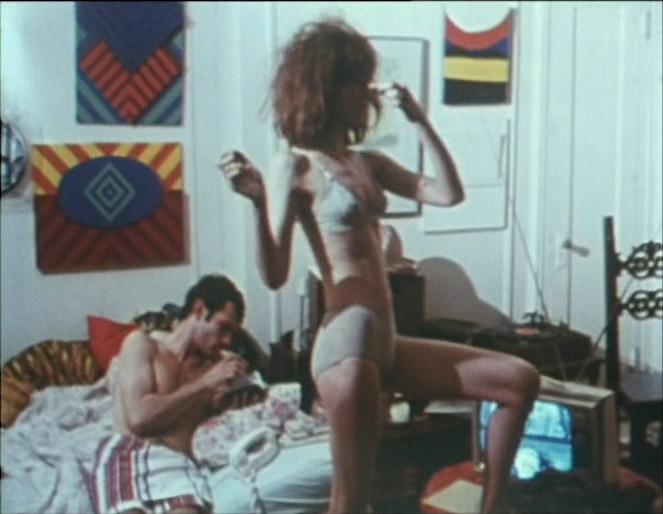
I, a Man (1967)
Written with Enzo Ungari; published under the title Introduction to the A.W. Method in Adriano Aprà, Enzo Ungari (eds.), Il cinema di Andy Warhol, Arcana, Rome 1971, pp. 1–18; republished in the second expanded edition of the book, 1978, pp. 3–20.