Around Order
- Mia Epnr
- Mia Epnr
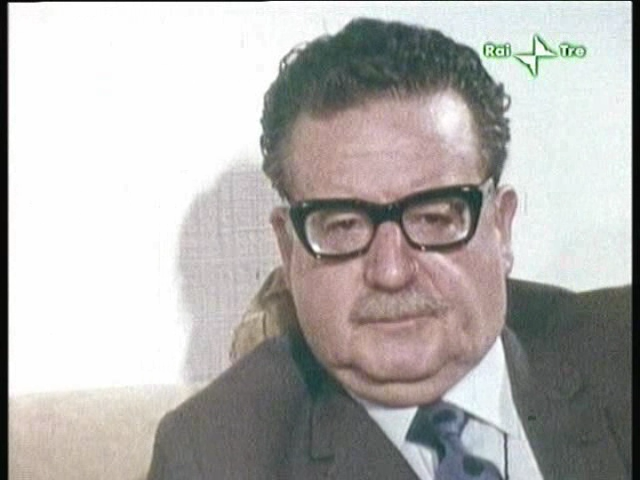
La forza e la ragione (1973)
In May of 1971, Roberto Rossellini visited Chile in preparation for two films that would never be shot. While there, he held an interview with then-president Salvador Allende. It was to be filmed in colour by Roberto Girometti, in two concurrent shots (comprising multiple takes each), with synchronous sound. The first shot looks towards Allende, zooms into his body, then his face, separating the details of his affect from Rossellini and the rest of the room before retreating back out, repeating this series of movements over the course of the film. The second is a reverse-shot of Rossellini, revealing his face (though his back is already present in the open stretches of the Allende shot) and the abundance of the room behind him. There is a clear contrast, when compared to the plain cream wall and brown cushions surrounding Allende. The second shot also shows Rossellini’s hands—he is holding a piece of paper that contains the questions he has asked thus far. The Pancinor remote that was so accustomed to sitting in the hands of Rossellini the filmmaker is missing.
The zoom that was at Rossellini’s full disposal for the television films came from the vantage point he retained over the subject of the films. Far from an obsession with the camera—in his own words, an “unbelievably childish” and “infantile”1 attitude towards work—technique came solely from the placement of himself in relation to the actors and the environment. There is the distance of history from the stories of the films, and there is the distance that occurs from sitting behind a camera and organising what is in front of it. Rossellini was acutely aware of what this distance meant for him, refusing to “...state [his] opinion”2 by cutting to a close.
It is less clear what this distance means for a viewer. There is no lack of an emotional hook to latch onto these figures—they’re humans, after all—and there is no claim to be made that the figures of history in Rossellini’s films are wholly alien to modernity. The distance is one that can be seen in the representation of the subject: that is, the subject is inherently at a remove from the camera. What becomes one of the great questions in Rossellini’s encyclopaedic work, then, is what exactly is the appropriate distance between the camera and each of the actions it records.
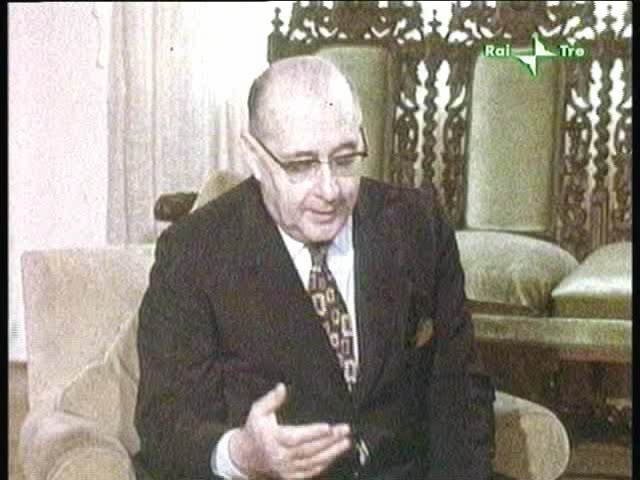
La forza e la ragione (1973)
The shot of Rossellini, unlike that of Allende, is mostly unmanned. The lack of activity in this shot is, like the furniture, telling of the differences between him and Allende. It is incorporated into the final edit far less than the shot of Allende precisely because it is a reversal of the encyclopaedia films. Because of the filming conditions, it would be absurd to argue that the shots of Allende, like the many long takes in the encyclopaedia, replicate Rossellini’s sight. It is too plain; the excitement towards seeing actors moving behind doorways, the shifts in their expressions, the light moving across their clothes, is missing. The zooms into Allende happen repeatedly, clinically, they are part of a simple routine. However, the reverse could be true: Rossellini is being seen by Allende. The stasis comes from Allende, the pragmatist—what he sees, from his place on the sofa, is a Rossellini much older than the man who made those films about the war and the ones with Ingrid Bergman. He sees a man mired by responsibility. When, at the end of the film, Allende says that he believes that man can move past the values of money and exploitation, and that we will end up “…living in a world where we are all brothers…”, he is reiterating to Rossellini what he already sees as a shared primary concern. A world past dogma, at least in the views shared between these two men, would be driven towards positioning the material as the basis for all further thought.
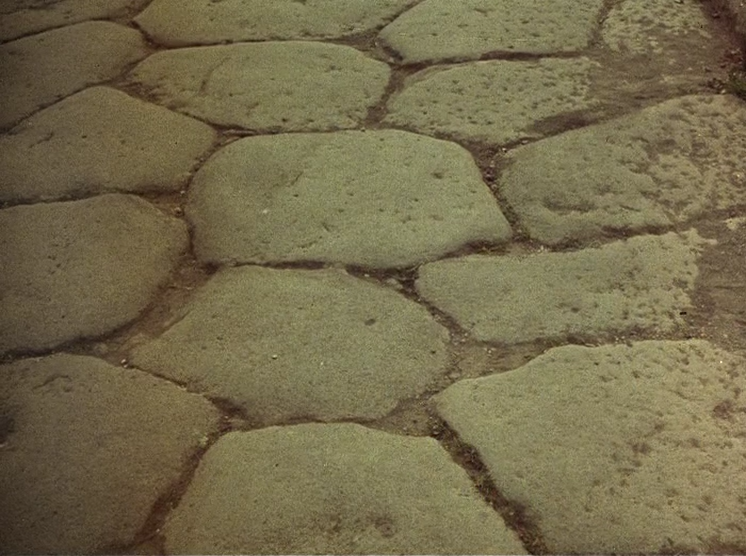
Agostino d’ippona (1972)
The first shot of Rossellini’s Agostino d’ippona (1972) is a handheld shot of the stones that comprise the roads Saint Augustine will travel on throughout the film. The cameraperson, mimicking Augustine, would have followed these roads themself. It serves as a sturdy base from which the rest of the film continues, assuring that the filmmaking crew will inhabit the spaces as much as the saint. They will have to walk the roads with him, and will have to stop when he stops. The final sequence of the film is staged wholly in an interior setting: Augustine delivers a sermon; he speaks of St. Paul, the suffering of the people, Christ, Jerusalem, Babylon, and the coming liberation to be found in God. It is, unlike the beginning, a spiritual conclusion, one that is only possible because Augustine has been traced in material terms. As he speaks, the camera pulls back over the devout crowd of listeners. The openness of what is insinuated by the path the film has traced, and the conjunction of image and sound, is impossible to describe.
So the question arises: what happens in the middle? What has occurred to facilitate such a stark difference? There are places, things, people; sometimes they die, sometimes, like the Bergman of Stromboli, they follow the path built with these stones, and wander off the screen. What happens to the people after the film? I could say, they continue on along their trajectory all too plainly mapped out by history. But is this right? Is it fair to say that Dary Berkani, a man about whom almost nothing is known (Tag Gallagher writes that he was a Filmmaker), who plays the titular saint of Agostino, is bound to his historical counterpart? Every event in the film leads to him sitting in front of that crowd—Berkani has no need for the roads once he stops playing Augustine.
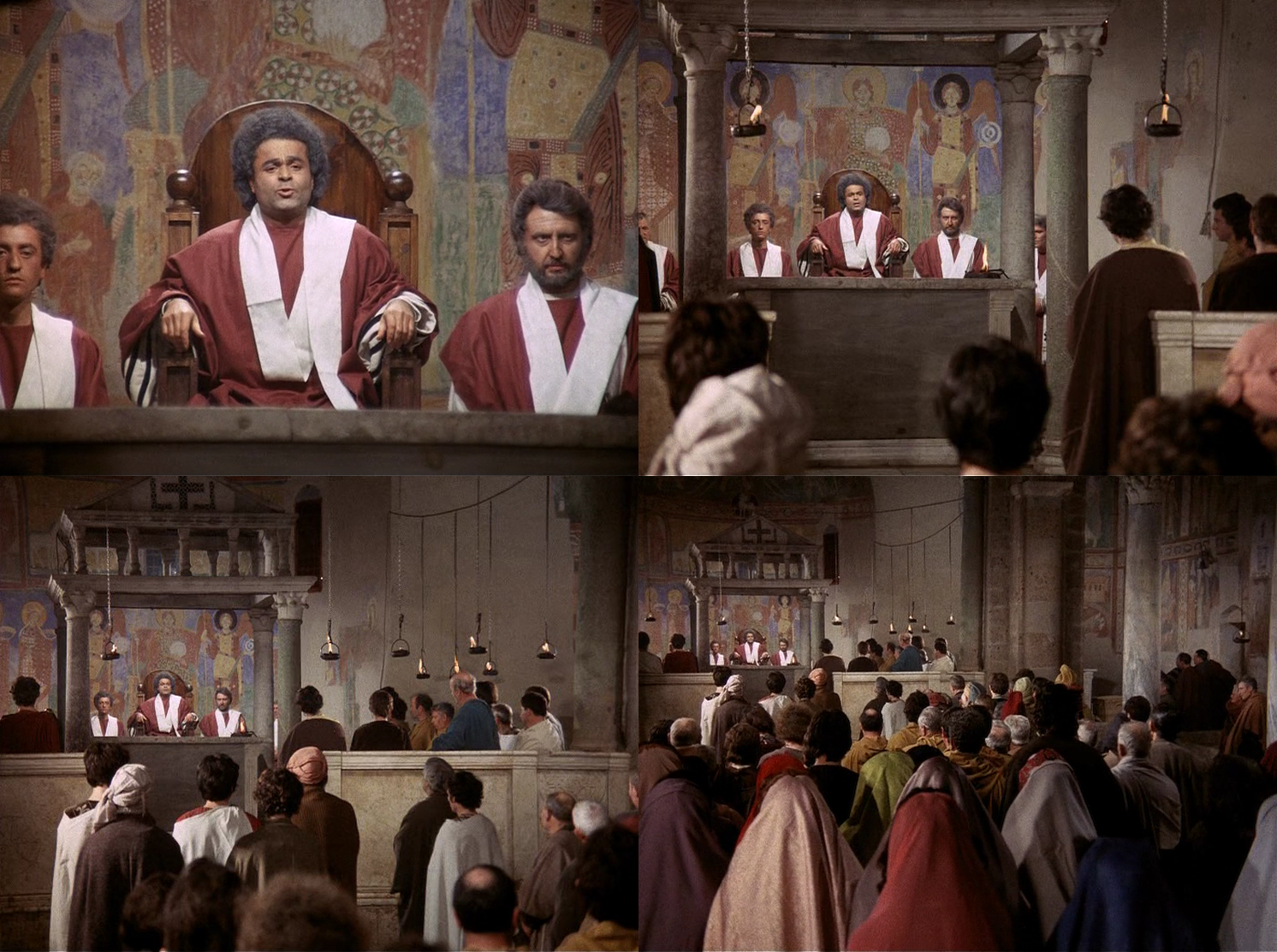
Agostino d’ippona (1972)
Adriano Aprà, in his text outlining a chronological order for Rossellini’s television films3, notes briefly that Rossellini has an affinity towards Warhol (he additionally names Griffith and Guitry). They share, as he puts it, a form of “primitivism”. In an extensive text on Warhol, Aprà writes at length about this primitivism: “What he seems to restore is not a mimesis of primitive films, but of the possibilities offered to cinema at its beginnings.” For Aprà, “It is no coincidence that cinematic prehistory interests Warhol, insofar as it marks the birth of the conditions of possibility for cinema itself.”4 This idea of primitivism brings with it the connotations of a linear progression, the ordering of events taking us from prehistory to history. The cuts at the end of the reels in Warhol’s Lupe (1966), upon which sight of Edie Sedgwick’s face is lost and all that can be seen of her is her back hunched over a toilet bowl, are a progression from the first images—Edie laying in bed/getting up in the first reel and her sitting at the dinner table in the second reel both culminate in Lupe’s death, at which point all that is unknown in the present collapses into the unknown of the historical. Tag Gallagher noted an important quality of Viva L’italia! (1961), though all of Rossellini’s television films share in this; that indoors, the eyes of the actors are always visible5. When the final image cuts and Berkani’s Augustine is gone, when the eyes of the actor pass with the final frame, they cannot come back.
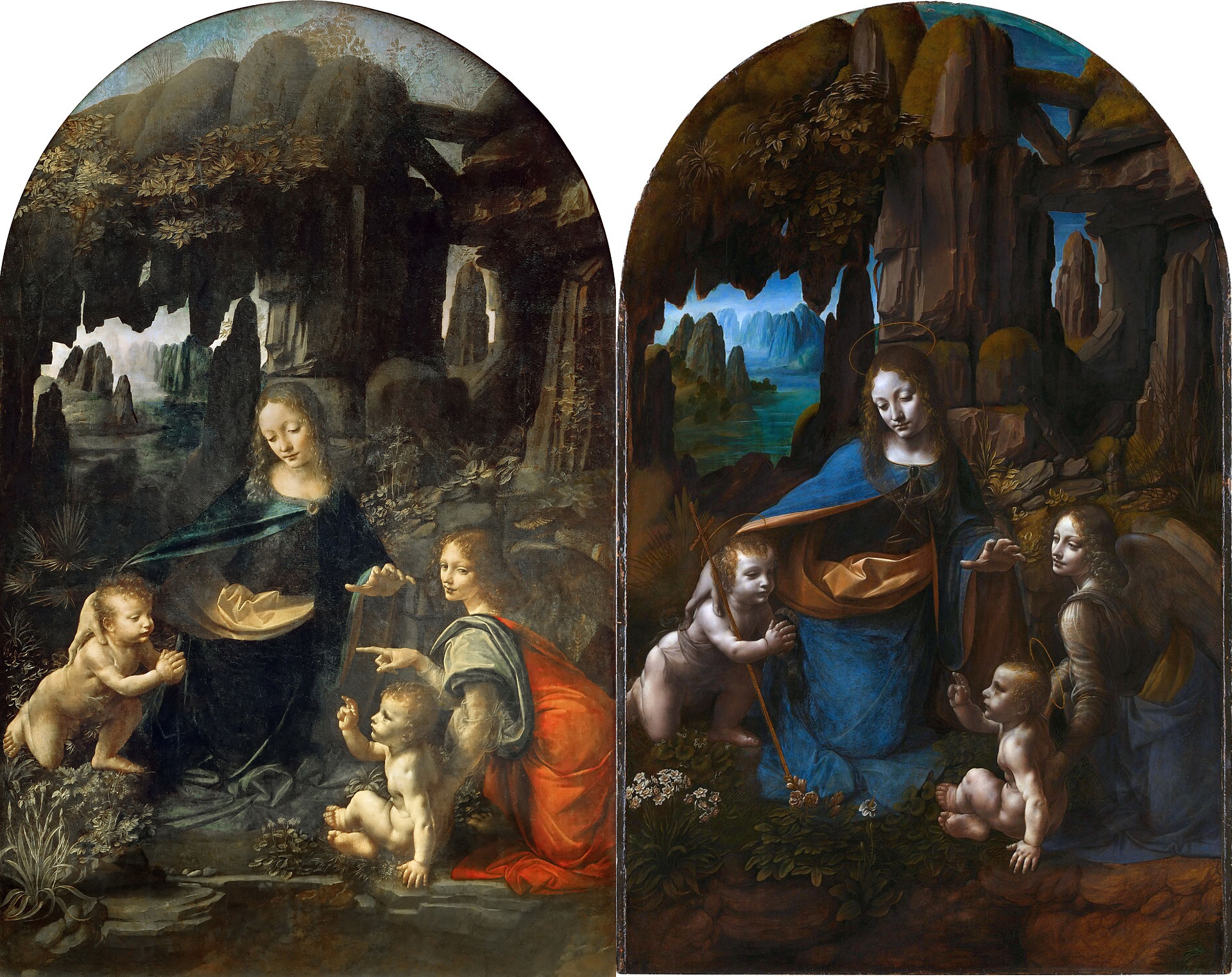
Vergine delle rocce Paris / London
Leonardi Da Vinci’s painting Vergine delle rocce exists in two versions: one held in the Louvre, the other held in the National Gallery in London. On the right side of the painting sits the angel Uriel, next to a newborn John the Baptist. In the Louvre version, he looks behind himself, off the canvas, pointing towards Jesus, as if directing the sight of a passerby. In the version held in London, Uriel looks towards the infant Jesus, with his hand down. The compositional difference between Uriel in both paintings is strange, and indicates a non-linear temporal relationship between both paintings. Ignoring the more subtle changes (the introduction of halos and a staff carried by Jesus in the London painting), it seems as if time has somehow shifted between them. Following this, the visual coldness of the London painting can become indicative of the weather turning, and the darkening of Mary’s right eye, like paintings of a weaker Christ, takes a more prophetic tinge. The difference is disorganised. Would it make more sense for Uriel to put his hand down before or after the cloud moves over, darkening the scene? Is he preparing to move? Is it colder because this imagined passerby has continued on their route to or from Egypt quicker? If it was as easy as one image relating to the other linearly, would these questions still arise?
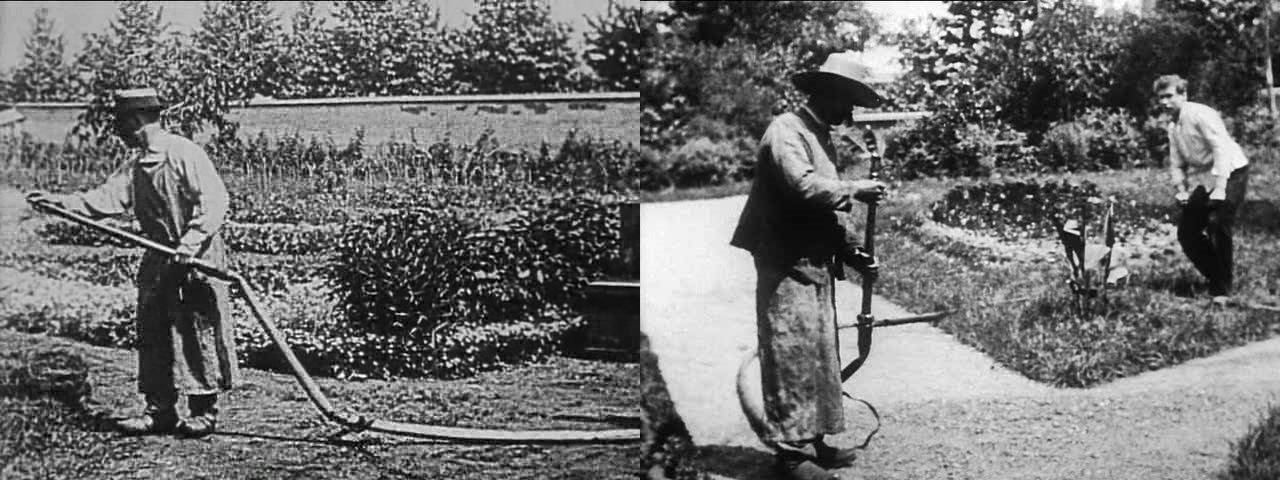
Two versions of L'Arroseur Arrosé (1895-96)
A primitive example of film order is demonstrated in Éric Rohmer’s filmed discussion with Henri Langlois and Jean Renoir on the films of the Lumières. Rohmer, unseriously, mentions to Renoir the potential to critique two of the Lumière hose films. Both films follow the same narrative sequence as a comic strip from Le Sapeur Camember. Rohmer's imagined criticism relies on the films not using the different shots that appear in the comic. Renoir responds by talking about the conditions with which the Lumière films were made, about the labour of replacing the film reel. Despite this, one can imagine an alternative where the two hose films, which are shot from different angles, are instead cut together, progressing through the outdoor space in conjunction with the development of the narrative (perhaps, when the man holding the hose looks down at it, before the boy lifts his foot).
Warhol’s Mario Banana and Mario Banana II share a similar relationship to the dual versions of Vergine delle rocce and the Lumière hose films. The first is shot in colour, the second in black and white, both at 18fps. The form of the first is noticeably bizarre: colour film at silent speed has very few predecessors (at least colour as it is captured in the camera, rather than painted or tinted on the frames). This anachronism is offset by the shift to black and white in the second film, which draws the two films back into an assumed film history. However, the first film is still alien to a simple chronology of film development; the anachronistic quality isn’t erased purely because an order is now alluded to. Like Da Vinci’s painting or Lumière’s hose films, there is a disruption of linearity. Just as a ray of light moving across a statue, all states of highlight and shadow become inherent to the work. Observe how the light in the first Mario Banana is harsh, sectioning off the top and bottom sides of our model’s face, and how in the second, it is completely flat, blending his features together. For Warhol and the sculptors before him, light had to be as much a considered material as stone, wood, metal or flesh. But it resists order, and rather expresses itself as a sur-order imposed on top of the order of sculpting, or, filmmaking.
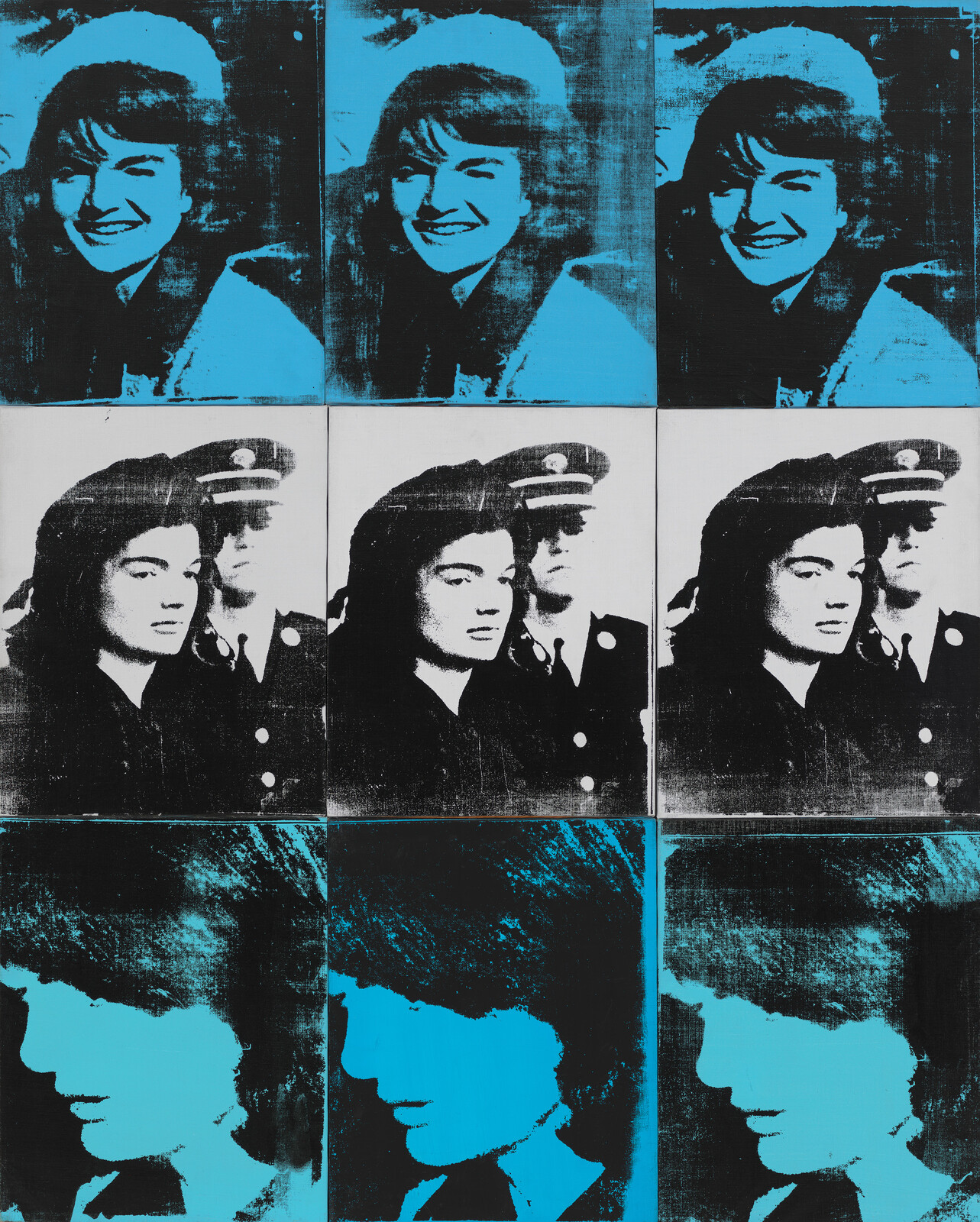
Nine Jackies (1964)
In Warhol’s work, the question of order isn’t limited to the realm of cinema. Peter Gidal, writing on the Jackie prints, expatiates on how little he sees them as relating to a traditional filmic order: “With the Jackie there is also a time-fragmentation.”6. Though it's not much different from the fragmentation of film editing, this time-fragmentation does reveal another way of seeing, through the organising of the prints. The still images that compose the Jackie series are individual parts which arose in sequence from before, the moment of, and after JFK was shot. They are typically arranged into grid structures, and are assumed to be seen from top left to bottom right. What does the image of Jacqueline's face point to? It is not as simple as a matter of reducing them to signifying grief or tragedy, because their meanings remain entirely open. It’s distinct from a traditional ambiguity because it is not a question of what is depicted or an obfuscation of meaning, it is rather—almost too clearly—a depiction of one thing. It’s reminiscent of what Rossellini himself said in 1976, “If I show the image of an elephant, the elephant is undoubtedly that and nothing else.”7
A notable quality of Rossellini’s encyclopaedia films is a general tendency towards tableaux. Characters sit a palpable distance away from the camera, which follows them without ever coming near. The line of opinion, demarcating the realm of the camera and the realm of the subject, is the line that Rossellini never wants to cross. Despite being set in antiquity, the films, through great care, retain within them the infinitude of a total knowledge which, in turn, expands itself to fill the container of film construction. Rivette put it most succinctly when he said that “a film is always presented in a closed form”8. Because, like the Renaissance so clearly rendered in L'età di Cosimo de Medici (1972), what a film presents as open yet complete is illusory. The shots, as much as they give the impression of reaching beyond themselves into the infinite future9, are necessarily contained by the confines of the film.
By its very nature, any total knowledge could not be expressed. If the inexpressible could be understood, there would be no space for thought to be formed between an nth number of things. Rossellini’s films, then, are semi-closed, self-completing systems, positioned to place the openings between each individual part in reach of the viewer. He saw clearly how opinion could close off the openings which a viewer can pass through, enlightening themselves. Rossellini’s order is the sur-order that expresses itself on top of the images, leaving the space between them open. His work as a filmmaker is the same as the work of light.
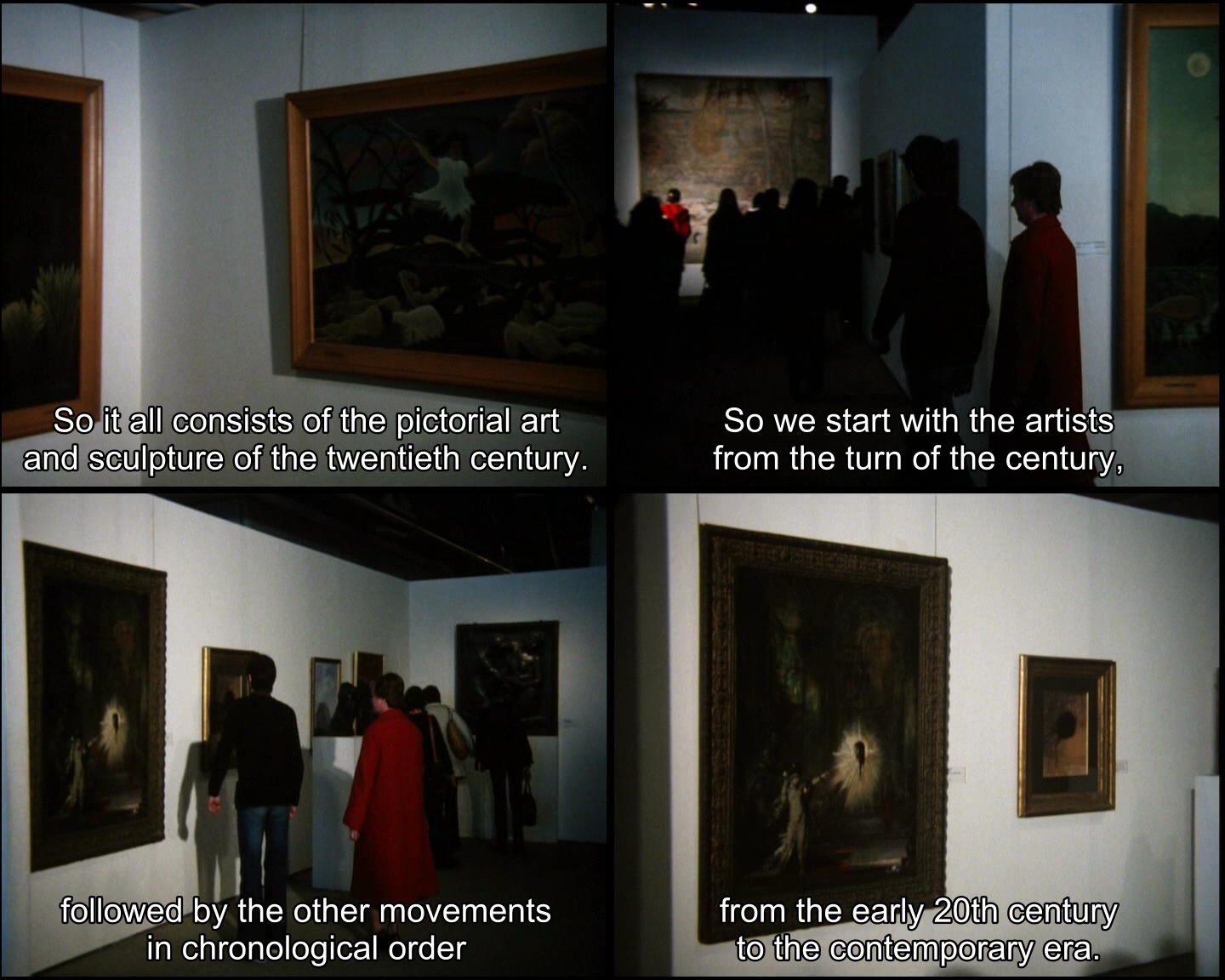
Beaubourg, centre d’art et de culture (1977)
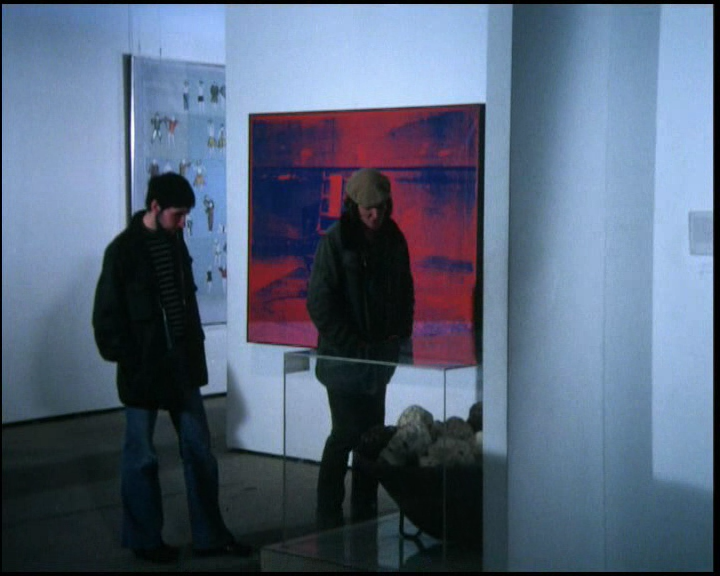
Shortly before his death, amidst planning for a biographical film on Karl Marx, Rossellini quoted a short passage from the Grundrisse: “The concrete concept is concrete because it is a synthesis of many definitions, thus representing the unity of diverse aspects.”10 The television films follow this idea by defining multiple points in history clear enough for a synthesis that allows for the concrete, objective view of history Rossellini believed was possible. His interest in and partial paralleling of Marx continues when he importantly acknowledged that “Marx is never dogmatic”11. Rossellini refuses to—and perhaps can’t—invent knowledge. Rather, like the arrangement of the Jackies and, in turn, the Beaubourg (closing his filmography), he orders images, paintings, sculptures, events and people, synthesising them into sequences within which they can express the knowledge that exists within and between their diverse aspects. When interviewed in 1973 by Cinéfilo, he said something apt: "I depart from the concrete to arrive at… anywhere, at the unknown.”12
But the television films aren’t where the question of order first appears in Rossellini’s work. Pedro Costa, when speaking of the progression in his own films, noted that he’d been “doing a parallel with Rossellini.”, that “He [Rossellini] started by making a film about a city, then a country, then a continent, and then Socrates. [...]it can get to a very difficult place where it’s really just about ideas.”13 Although Costa is correct when he says that order is the consolidating theme of Rossellini’s filmography, it is not as deterministic as he puts it. Rossellini knows well that there is a destination, but not so much what the route there is nor what it will entail. To reinterpret Costa’s thought, upon Viva l’italia!, like Warhol, the unknown of the present made way for the unknown of the historical expanse.
Anno uno (1974)
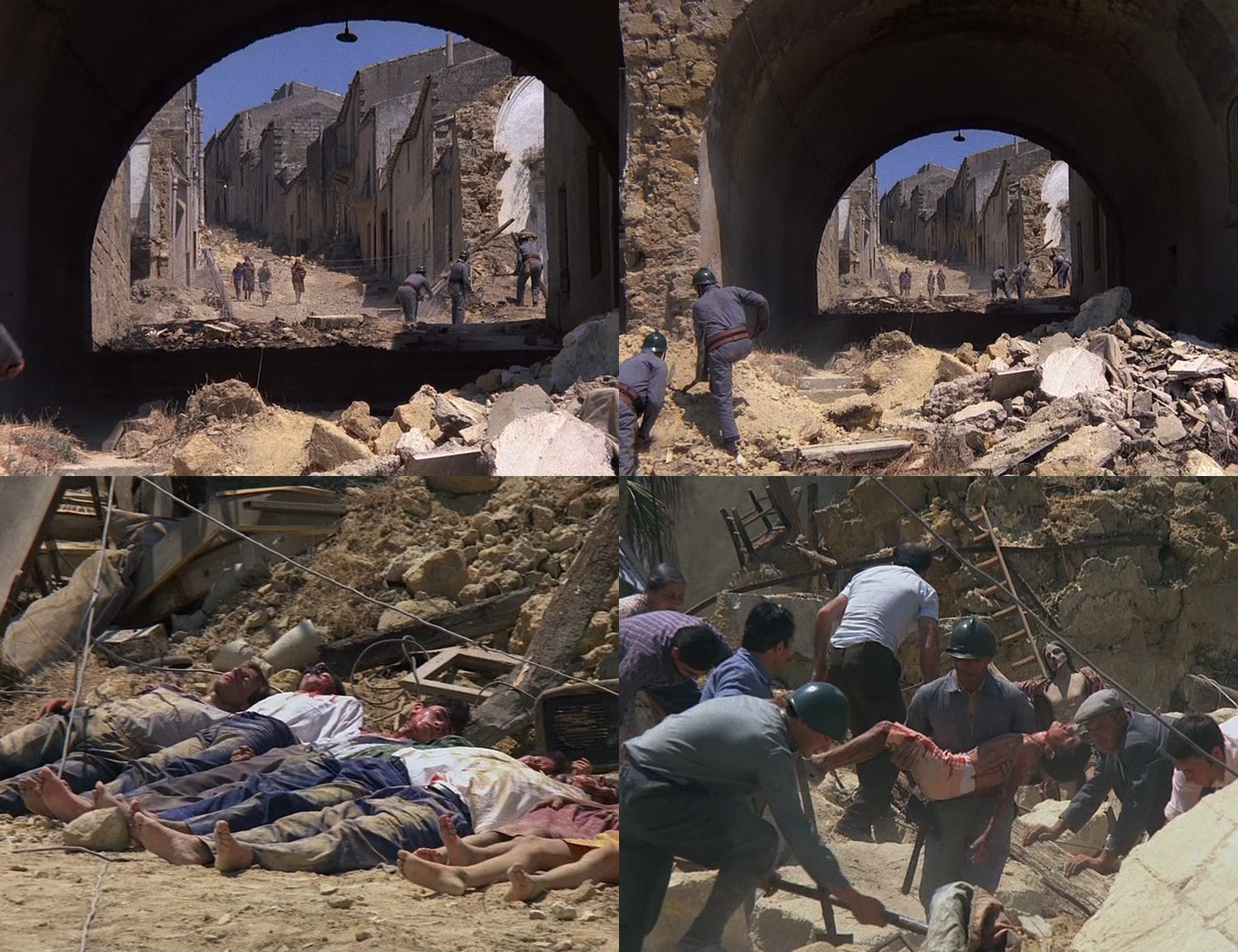
Anno uno opens with a shot of tanks moving through a field. The camera swings to an aid tent on the right, before finally resting on a group of refugees. An old man speaks to some soldiers: he has been walking for three days, he has “…lost everything…” and that “if the Allies don’t defeat the Germans soon the whole of Italy will be in ruin.” The film continues, reaching a ravaged town. Amidst the ruins, a sequence begins with a shot through a semi-circular tunnel, it then cuts into a pan across dead civilians, which moves up to the people working to recover bodies from the destruction, and finally, briefly, across a sculpture of Christ with women and men toiling alongside it. A terse rhyme arises when this beginning is thought of alongside the ending of Germania anno zero (1948), in which the young boy Edmund commits suicide by jumping through a hollowed out building. His death is an unknown, because his reasoning is impossibly shrouded. All we’re privy to is the decision. The camera looks down on the boy, having followed him up the building; there is a clear difference in perspective between this camera and the one that stays level with the volunteer workers, hinting towards the final shift that will be reached in Beaubourg. The geographical displacement between Germania and Anno uno has facilitated in Rossellini—to paraphrase Straub—the ability to understand the street because it is a street he has seen. The streets in the background of Germania possess a newsreel quality: there is the proximity to the war and the reporter's sensibility and, like the contemporary newsreels, it is rife with the opinion of the filmmaker(s) behind the camera. It is surprising, then, that when the aforementioned sequence in Anno uno ends and the film moves into an occupied Rome, the glass paintings, which are totally flat—unlike anything in Germania—take on a greater sense of depth. Is it because of the film's aversion to harboring the singular opinion of the filmmaker that there is the clarity to see things in their whole?
L'arrivée d'un train à La Ciotat (1896) / Anno uno (1974)
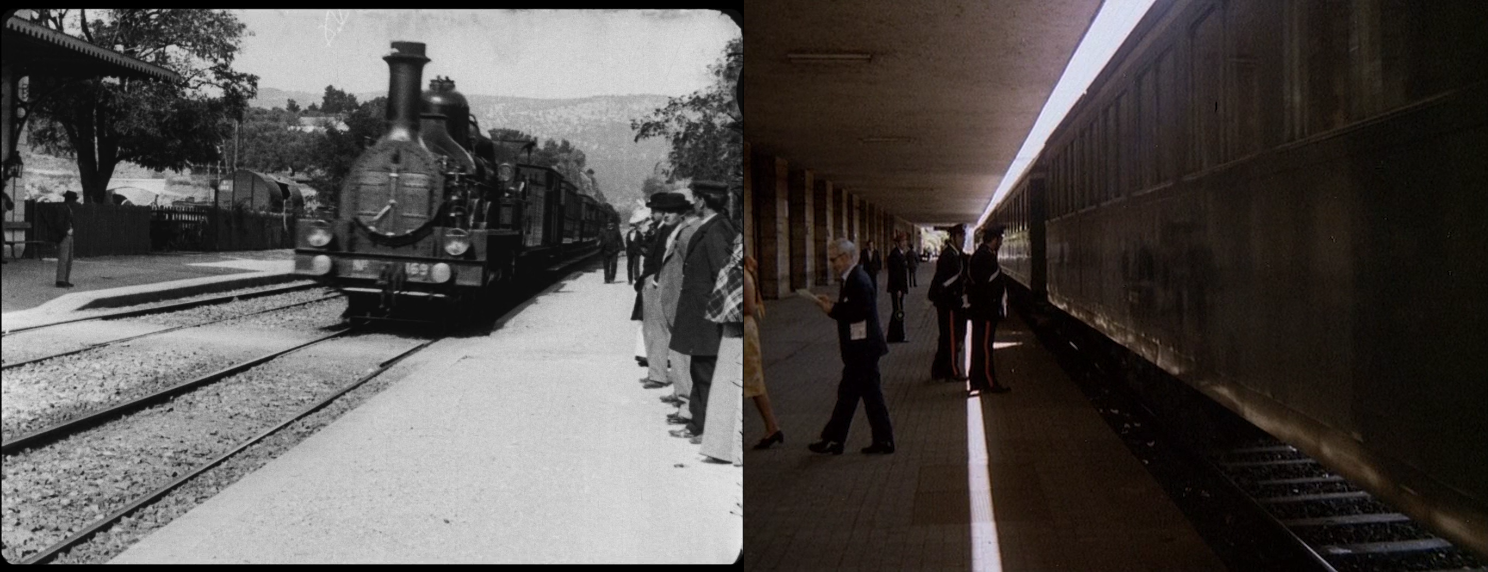
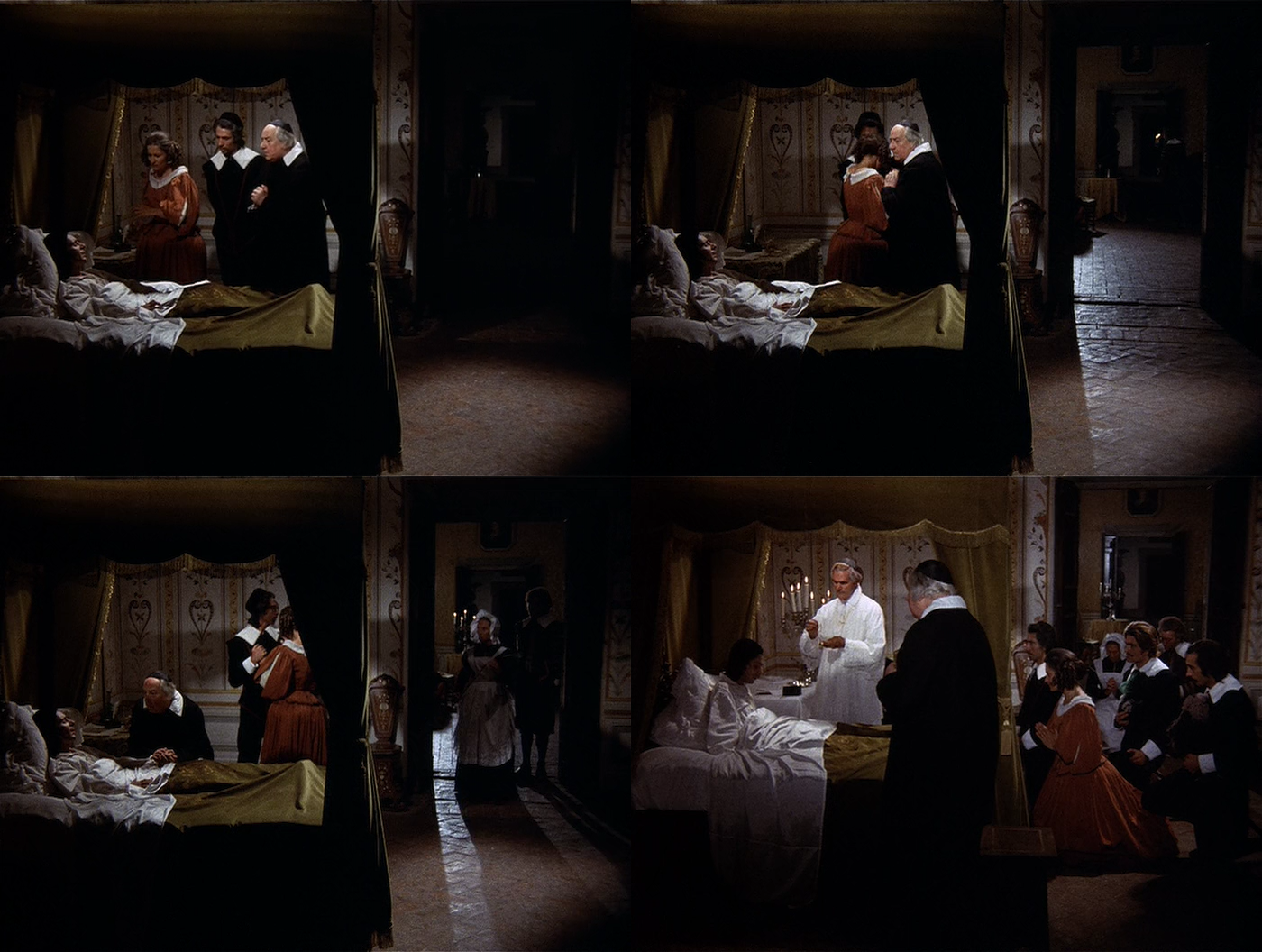
In the final shot of Anno uno, Alcide De Gaspari, the dogmatic, anti-communist Christian Democrat, whom we’ve just seen reconstruct Italy after the war, boards a train. We know he is off to die—it is an overwhelmingly somber moment. Rossellini has retained his vantage over Gaspari. Allende the Socialist, voted in through a democratic election, took his own life in 1973, during the coup d’état that would institute the military dictatorship. It reflects back onto Rossellini, who would die in 1977, shortly after finishing Beaubourg, where he steps down and places himself amidst the crowd—everything he hears and sees comes from within the masses. As his camera moves across the paintings, his sight is no different from the people walking past. What a change this is, to know that nobody captured on film has a life mapped out for them by history, to know that, when the film ends, they keep living. So, when Warhol’s Big Electric Chair is revealed as the camera moves around a corner, bringing with it death, what else is there to feel but the threat it imposes onto the space around it? It’s only glanced over quickly—Rossellini is much more interested in the people walking past, the life of the shot. He knows that there is more to be learnt from them. It rhymes with the ending of Blaise Pascal (1972): as Pascal lay dying, in shade, the people in his room move around in clear light, opening doors, walking through doorways, reflecting the light from outside. The act of death is everpresent, but life takes precedence.
Beaubourg, centre d’art et de culture (1977)
Blaise Pascal (1972)